
 23 Tumanyan St, Yerevan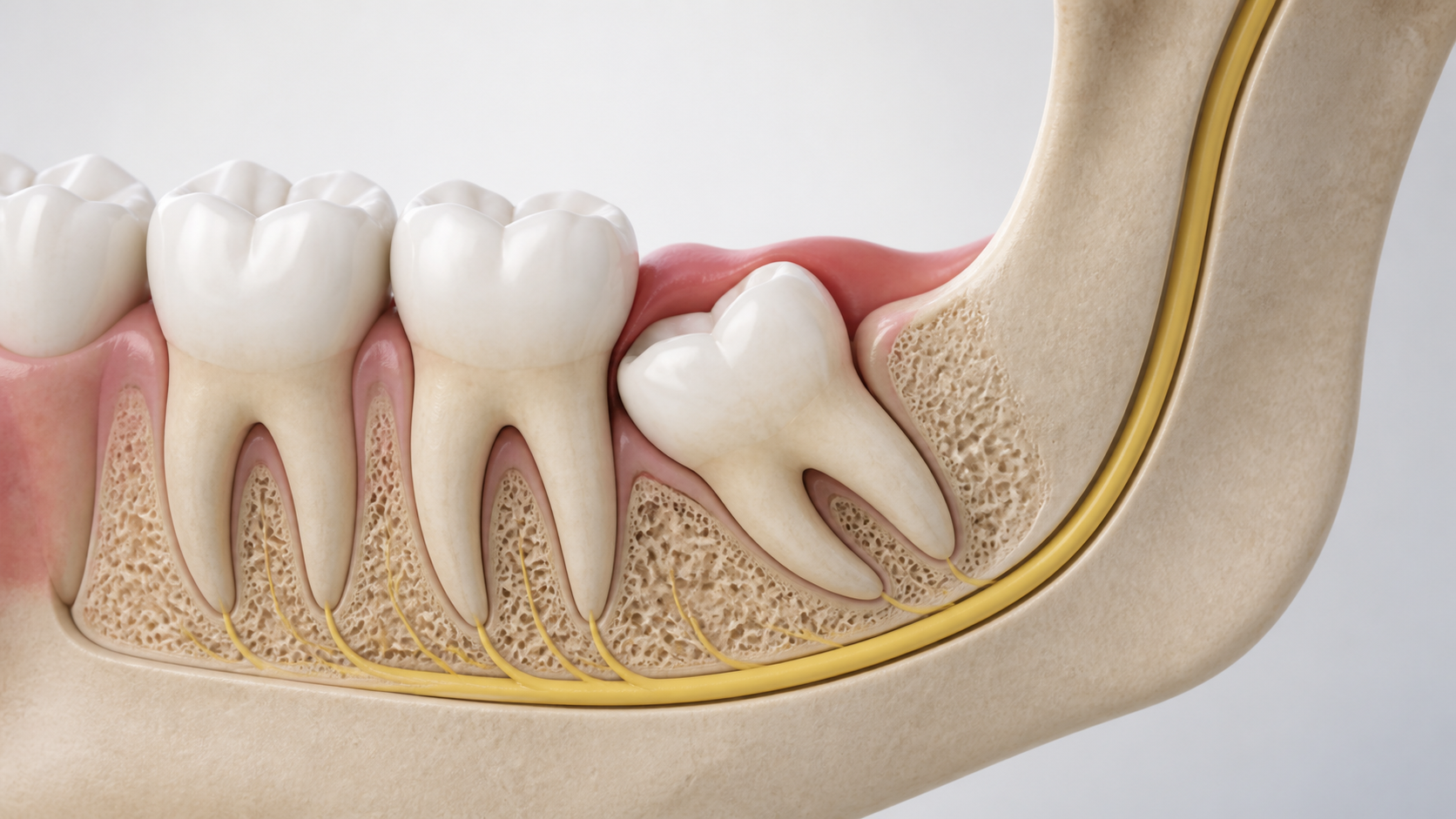
Key points in one minute
Key point: a wisdom tooth is not removed simply because it is a wisdom tooth; the decision depends on position, disease and individual risk
- An impacted wisdom tooth has not fully erupted or cannot reach a normal position; it may stay quiet for years but still needs appropriate monitoring.
- Pain, swelling, a bad taste, difficulty opening the mouth or recurrent gum inflammation around the tooth are reasons to arrange an in-person dental assessment.
- Imaging shows the roots, the adjacent tooth and nearby anatomy; the clinician, not an online article, decides whether CBCT is useful.
- After removal, worsening pain, fever, increasing swelling, persistent bleeding, or trouble breathing or swallowing need urgent help.
What wisdom teeth are and why they can cause problems
Third molars usually develop last, often in the late teens or early adult years. There may not be enough room in the jaw, so the tooth stays partly or completely under gum or bone, leans towards the tooth in front of it, or only part of the crown emerges. This is called impaction; an unusually angled or positioned tooth may be described as ectopic or displaced.
A partly erupted lower wisdom tooth can be covered by a flap of gum. Plaque and food can collect in this difficult-to-clean area and cause inflammation around the crown, known as pericoronitis. Decay in the wisdom tooth or the second molar, gum disease, and more rarely a cyst can also occur. Impaction on its own, however, does not automatically mean extraction.
- A healthy, well-positioned third molar that can be cleaned may be monitored.
- Symptoms can be mild or intermittent, so decisions are made from an examination and images.
- Do not try to determine tooth position from pain, a photograph, or another person's experience.
Symptoms and diagnosis: what the dentist checks
Reasons to book a consultation include pain at the back of the jaw, gum or cheek swelling, an unpleasant taste or smell, difficulty opening the mouth, pain on chewing, or repeated inflammation. These symptoms do not prove a particular diagnosis: decay, gum disease, a problem with the adjacent tooth, or a temporomandibular joint condition can feel similar.
At the visit, the clinician compares symptoms with an oral examination and the condition of the gums and adjacent teeth. An X-ray can show the direction of growth and roots. For a complex lower wisdom tooth, the specialist may decide that CBCT is needed to assess the three-dimensional relationship of the roots to the inferior alveolar nerve. Imaging and treatment choices are individual.
| Situation | What is assessed | Possible next step |
|---|---|---|
| No symptoms and the tooth is accessible | Position, cleaning, and the adjacent tooth | Routine monitoring and preventive visits |
| Partly erupted with inflamed gum | Signs and recurrence of pericoronitis, local cleaning | In-person care and discussion of the cause |
| Tooth leans towards the second molar | Decay, gum health, and risk to the neighbouring tooth | Discussion of keeping or removing it after imaging |
| Roots are close to the nerve canal | Individual risk to sensation | Further imaging and discussion of options |
Treatment: monitoring, inflammation care and removal
A clinician may recommend monitoring when there is no sign of disease and the tooth can be followed safely. With inflammation, the severity is assessed first and the local cause is managed in person. Antibiotics, antiseptics and pain medicines are not a universal home solution: only the treating team can assess indications, contraindications and interactions.
Removal may be considered for recurrent infection, decay that cannot be restored, damage to an adjacent tooth, a cyst or other disease. When a lower wisdom tooth lies close to a nerve, the surgeon should explain the risk of temporary, and occasionally lasting, altered feeling in the lip, chin or tongue. In selected cases, coronectomy—removing the crown while leaving roots in place—may be discussed, but it is not suitable for everyone.
- Ask what the images show and which alternatives are realistic in your case.
- Tell the team about chronic conditions, pregnancy, allergies and all regular medicines.
- Do not stop prescribed medicines or start antibiotics without individual instructions.
Recovery and red flags
Moderate soreness, swelling, jaw stiffness and uncomfortable chewing can occur after a procedure; the expected course and instructions depend on the complexity of removal and the type of anaesthesia. Follow the surgeon's written advice, including any advice about smoking or protecting the surgical area.
Contact the dental team promptly if bleeding does not stop, pain or swelling clearly worsens, or you develop fever, discharge, a bad taste with worsening wellbeing, or other concern. Seek emergency help for difficulty breathing or swallowing, rapidly spreading swelling, a severe allergic reaction, or marked weakness.
- Which sign in my case means I should contact the clinic?
- Does my image show a risk to a nerve or the adjacent tooth?
- Which options, risks and limitations apply specifically to me?
Save before your visit
Questions worth asking your dentist
- Does this wisdom tooth need monitoring, and how often?
- Which image is needed for a safe decision?
- What are the risks and alternatives to removal in my case?
- Which symptoms after a procedure require urgent contact?
Sources
- Wisdom tooth removal — NHS
- Wisdom Tooth Management — American Association of Oral and Maxillofacial Surgeons
- Wisdom tooth surgery: advice for patients considering coronectomy — University College London Hospitals NHS Foundation Trust


