
 23 Tumanyan St, Yerevan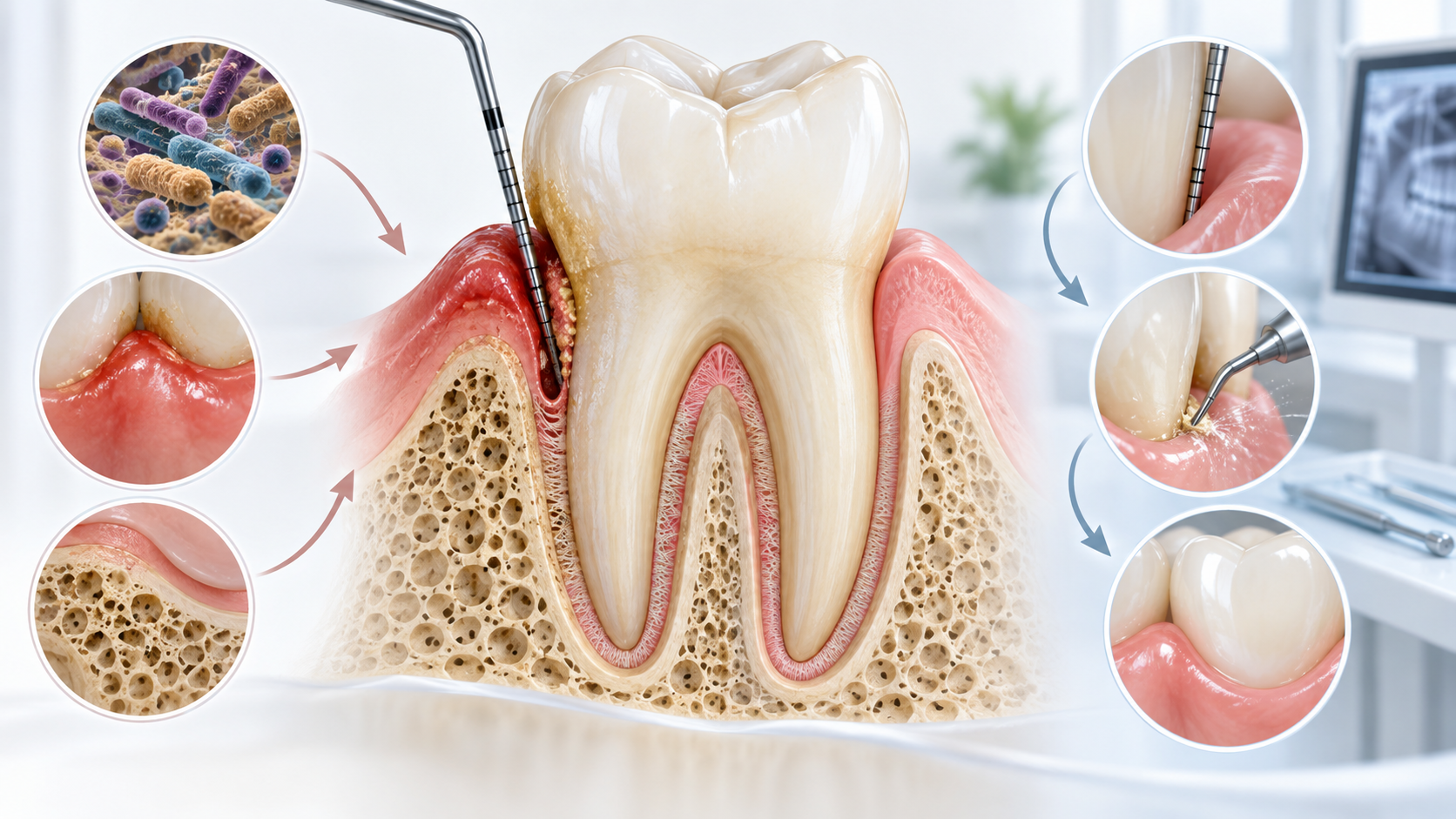
Key points in one minute
The key point: early assessment and regular supportive care allow a realistic discussion about keeping teeth
- Periodontitis affects the gum, periodontal ligament and bone around a tooth; bleeding or one radiograph alone cannot reliably confirm it.
- Assessment may include probing depth and bleeding, attachment level, mobility and imaging interpreted alongside the clinical examination.
- Care is usually stepwise: plaque control and risk-factor management, professional treatment, reassessment and, for selected sites, additional measures.
- Supportive visits and daily cleaning matter after active treatment; the review interval is individual rather than one-size-fits-all.
- Rapidly increasing swelling, fever, difficulty swallowing or difficulty breathing require urgent in-person medical care.
What periodontitis is, and how it differs from gingivitis
The periodontium is the group of tissues around a tooth: gum, periodontal ligament, root cementum and alveolar bone. With gingivitis, inflammation is limited to the gum and is generally reversible once its cause is addressed. With periodontitis, inflammation is associated with loss of attachment and supporting bone around teeth. The clinical task is therefore not simply to reduce visible redness, but to establish whether support has been lost and how extensive that loss is.
The disease can progress slowly and cause no pain for a long time. Bleeding during brushing, swelling, bad breath, exposed root surfaces, new spaces between teeth, a sense of mobility or a changed bite are reasons to arrange an examination, but each has other possible causes too. Under current classification, a clinician describes stage and rate of progression from the whole set of findings rather than from a single sign.
Causes and factors worth discussing
Dental plaque biofilm has a central role in inflammation, and hardened deposits make effective home cleaning harder. Smoking and other tobacco use, poorly controlled diabetes, previous periodontitis, daily-care routines, crowded teeth, overhanging restoration edges and some medicines can also affect risk or the course of disease. A risk factor does not mean that a person already has periodontitis; it helps the clinician make the assessment and plan more precise.
It is useful to share information honestly about oral hygiene, tobacco, long-term health conditions, pregnancy, medicines and recent changes in how you feel. This is not a formality: it can influence the interpretation of findings, the safety of procedures and the follow-up plan. The World Health Organization also identifies poor oral hygiene and tobacco use as major risk factors for periodontal disease.
- How often, and with what method, do you clean between your teeth?
- Do you notice bleeding, bad breath, sensitivity or mobility?
- Is there tobacco use, diabetes, long-term medication or previous gum treatment?
- When did you last have professional cleaning and dental radiographs?
How assessment works: periodontal charting and radiographs
In-person assessment starts with symptoms, treatment history and examination. A clinician may use a periodontal probe to measure sulcus or pocket depth at several surfaces around each tooth, recording bleeding, gum recession, clinical attachment level, plaque, mobility and root involvement. This map is often called a periodontal chart. It is not for self-diagnosis: it enables site-by-site comparison and tracking over time.
Radiographs help assess the bone between teeth and other potential causes of symptoms, but they do not replace soft-tissue measurements and clinical examination. A clinician may choose focused images or another investigation when indicated; the extent is individual. After the assessment, ask for a plain-language explanation of which findings support the diagnosis, which teeth have a limited prognosis and what will count as improvement at review.
| Information | Why it matters | What it cannot establish alone |
|---|---|---|
| Bleeding and gum appearance | Shows signs of inflammation | The stage of periodontitis |
| Periodontal chart | Compares pockets, attachment and mobility | One overall prognosis without history and images |
| Radiographs | Help assess bone level and nearby structures | Gum condition without clinical examination |
Treatment and prognosis: why care is usually stepwise
The European Federation of Periodontology describes treatment for stages I–III as a sequence. First, the clinician and patient work on plaque removal, workable home-care technique and modifiable risk factors. Professional removal of deposits above and below the gumline may follow when indicated. After healing, the result is reassessed: some sites respond to non-surgical care, while persistent deep pockets or complex anatomy may lead to discussion of additional non-surgical or surgical options.
With pronounced mobility, splinting may sometimes be considered as part of a plan, but it does not remove the cause of inflammation and is not right for every situation. Removal of a tooth and replacement options may be discussed if it cannot be retained reliably. That decision depends on bone, root condition, decay, cracks, loading and the overall plan. No article can promise the same treatment duration or retention of every tooth; prognosis becomes clearer after assessment and tissue response.
| Step | Aim | What is decided next |
|---|---|---|
| Education and factor control | Make daily cleaning achievable | Which habits and tools suit you |
| Professional treatment | Reduce inflammatory burden | Whether particular sites need review |
| Reassessment and additional measures | Check pockets and inflammation after initial care | Whether more complex procedures are needed |
| Supportive periodontal care | Reduce the chance of recurrent deterioration | An individual recall interval |
What to do at home, and when not to wait for a routine appointment
Until a consultation, continue gentle brushing twice daily with fluoride toothpaste and clean between the teeth using a method previously demonstrated by a professional. Do not try to ‘clean out’ a pocket with sharp objects, use harsh solutions or start medicines or antibiotics because of an article. Home care matters, but it cannot replace professional assessment of deposits below the gumline and the reason for loss of support.
Seek in-person help without delay for rapidly increasing swelling of the face, mouth or neck, fever with worsening general condition, severe pain, injury, or difficulty opening the mouth, swallowing or breathing. For routine bleeding or a concern about your gums, arrange a consultation in Yerevan and bring previous radiographs if available. When choosing care, you can ask about the plan, alternatives, review points and how medical activity is licensed in Armenia.
Save before your visit
Questions worth asking your dentist
- Can gingivitis and periodontitis be distinguished without periodontal charting?
- Why is reassessment needed after professional cleaning?
- Does every deep periodontal pocket require surgery?
- How often is supportive care needed after treatment?
Sources
- Guideline on treatment of stage I-III periodontitis — European Federation of Periodontology
- Oral health — World Health Organization
- Medical care licensing application — Republic of Armenia e-Government


