
 23 Tumanyan St, Yerevan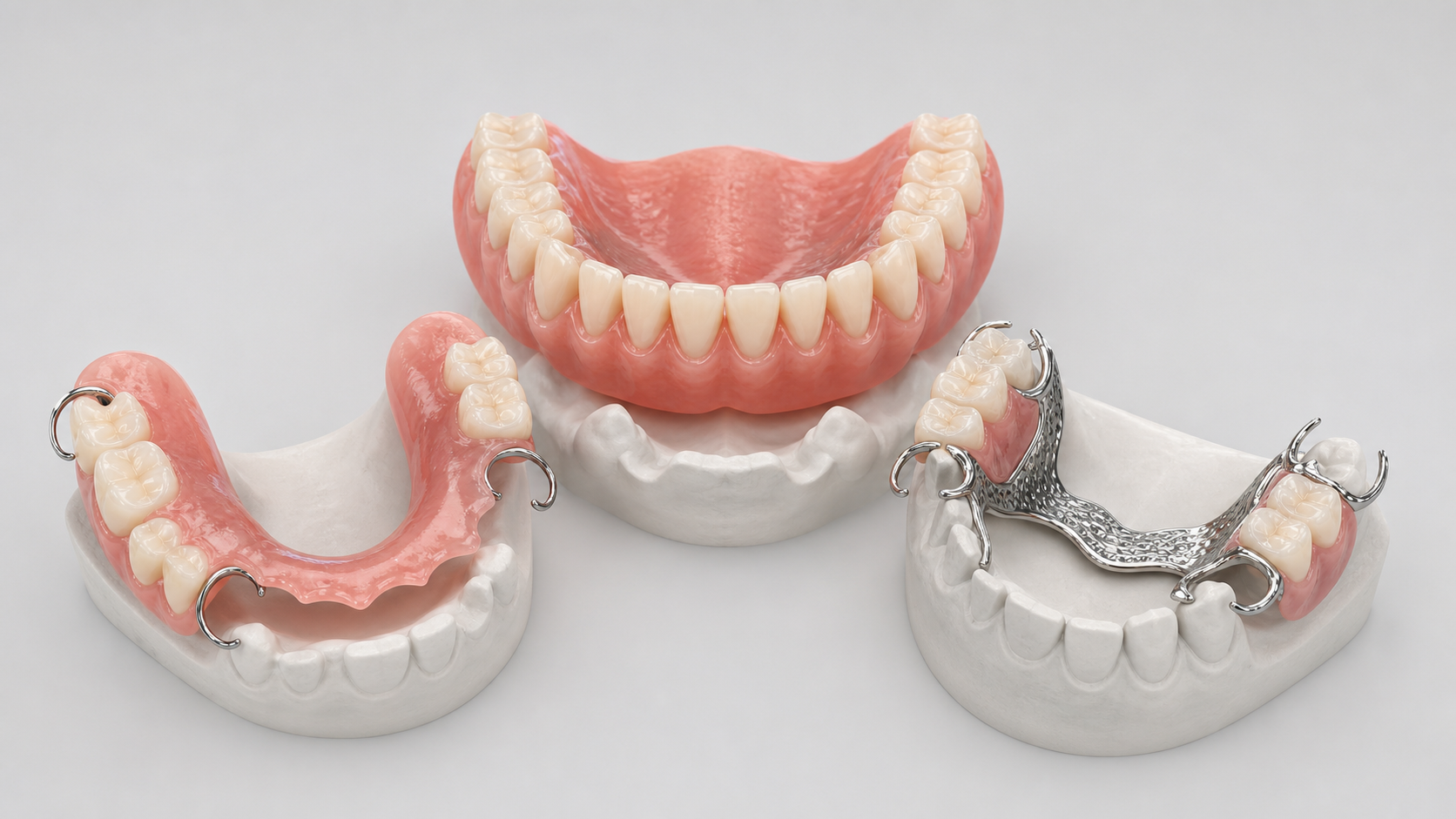
Key points in one minute
The main thing: a removable denture is selected according to the support, fabric and observation plan, and not just according to the material
- Complete dentures replace all the teeth in one jaw, while partial dentures replace one or more missing teeth; the removable structure should not be adjusted independently.
- Acrylic, nylon and clasp options differ in support, rigidity, volume and repairability, so they cannot be fairly ranked without inspection.
- In the first weeks, there may be a feeling of volume, changes in diction, and difficulty eating; pain, rubbing, mobility or crack is a reason to contact your dentist.
- Implants, bridges, and implant-supported dentures may be an alternative in some situations, but require separate evaluation of health and anatomy.
What is a removable denture and what problem does it solve?
Removable dentures are artificial teeth on a base that rests on the gums, and in case of partial loss of teeth, they can be additionally held on to the remaining teeth by clasps, locks or another fixation system. A complete denture is used when all teeth in the upper or lower jaw are missing; partial closes individual defects. Their task is to help restore chewing, speech and appearance within the capabilities of a particular design.
Not every removable structure “fits” equally. Stability is influenced by the shape of the jaw, the volume and condition of the tissues, salivation, bite, location of the remaining teeth and compliance with recommendations. After tooth extraction, tissue changes during healing, so the immediate temporary denture often requires adjustments, relining, or subsequent replacement. This is a normal part of planning and not a sign of failure.
Conditionally removable are sometimes called structures that a doctor can remove for maintenance, for example, implant-supported dentures. For the patient, the rules of care and visits are determined by a specific plan. This option should not be considered “the same” as a conventional complete denture: the indications, preparation and maintenance are different.
Acrylic, nylon and clasp: how the options differ
Acrylic dentures usually have a plastic base. It is often used as a complete denture, temporary solution, or partial restoration; when the situation changes, in some cases it is easier to adjust it. Flexible polymer, sometimes called nylon, designs may be less noticeable, but are not automatically more comfortable or suitable for everyone: load distribution, hygiene and adjustability are important.
The clasp denture has a metal frame and usually rests on the remaining teeth. It may occupy less volume in certain areas, but requires careful evaluation of the abutment teeth, periodontium, and structure. Clasps or precision fastenings have their own planning requirements; sometimes preparatory procedures on the teeth are necessary for a secure fit.
When choosing, it is useful to compare not advertising names, but the task: how many teeth are missing, whether there are stable supports, how well hygiene is maintained, whether changes are expected after removal, whether it is possible to come regularly for correction and what kind of care can realistically be performed at home.
| Option | Possible task | What to clarify during consultation |
|---|---|---|
| Full removable | Replace all teeth in one jaw | How will the adaptation take place, are any corrections needed and how to store the structure? |
| Partial acrylic | Temporarily or permanently fill part of the teeth | What does it rely on and will it be possible to change the design if another tooth is lost? |
| Byugelny | Distribute the load using the remaining teeth | Are the supporting teeth healthy enough and how to clean the attachments? |
| Supported by implants | Improve retention in selected cases | Is the anatomy and health suitable for implantation, what steps and maintenance will be required? |
Diagnostics, manufacturing and adaptation
Treatment begins with an assessment, not an impression. The dentist discusses symptoms and goals and examines the oral tissues, remaining teeth, gums and bite; diagnostic images or other tests may be needed. Active inflammation, tooth decay, unstable supporting teeth and poor plaque control usually require attention before the final restoration. This avoids placing a denture on an unstable foundation.
After agreeing on the plan, impressions are taken or digital scanning is performed, the shape and position of the teeth are determined, blanks are tried on and the data is transferred to the laboratory. Upon delivery, the doctor checks the fit, closure and pressure areas, explains insertion, removal and care. Sometimes several visits are needed: a small correction can have a significant impact on comfort.
In the first days, the new design often feels bulky, pronunciation may change, and it is more convenient to eat soft food in small pieces, distributing the load on both sides. Do not try to “shrink” the partial denture by biting on it; this may damage the attachments. Follow your doctor's instructions about wearing time and nightly removal - these may differ in the early period after tooth extraction.
- Ask whether the design's purpose is temporary, transitional, or long-term.
- Find out what sensations are expected for your prosthesis during the adaptation period.
- Write down how to store, clean, and handle if your denture chafes or breaks.
- If you do not live in Yerevan or are visiting for a short time, discuss the plan for follow-up visits and corrections in advance.
Care, relocation, repairs and the boundaries of home care
The denture and oral cavity are cleaned daily. The removable structure is usually washed after eating and gently cleaned with a suitable product; regular toothpaste and abrasive household cleaners can scratch the material. The remaining teeth, gums, tongue and palate also need regular hygiene. Without it, the risk of plaque, inflammation, unpleasant odor and problems with supporting teeth increases.
Over time, the gums and jawbone change shape, so the fit may be compromised. The dentist may suggest an adjustment, a reline—changing the inner surface for a better fit—or a replacement design. There is no universal deadline: they focus on well-being, examination, wear and changes in tissues.
Do not file the base, straighten the clasps, glue cracks with household glue, or use DIY repair kits. This can injure the mucous membrane, spoil the fit, or complicate laboratory repairs. If the denture cracks, a tooth falls out, or the structure becomes noticeably looser, save all parts and contact the clinic.
Alternatives and realistic results
Bridging and implantation may be an alternative in some cases. The bridge is fixed to adjacent teeth, and the implant serves as a support in the bone for a crown, bridge or part of a removable denture. These methods are not automatically suitable for everyone: they take into account bone volume, the condition of the gums and teeth, general health factors, the extent of treatment and the possibility of care. The decision is wise to make after discussing the pros, limitations and maintenance of each option.
A realistic result - a design that corresponds to the agreed task, does not injure the tissue after the necessary corrections and allows for maintaining hygiene. It does not return the natural tooth “as it was” and does not cancel examinations. Eating and speech are usually adapted gradually, but exact comfort, durability, and the need for alteration cannot be guaranteed in advance.
The article is for informational purposes only. If there is pain, inflammation, difficulty wearing or doubts, do not diagnose yourself on the Internet: an in-person consultation with a dentist will help check the tissues, fit and safe options for further action.
Save before your visit
Questions worth asking your dentist
- What defect needs to be restored and what tissues or teeth will the prosthesis rest on?
- What options are appropriate for me, including bridges and implant support, and why?
- What preparation and follow-up visits will be required before and after issuance?
- What signs mean that correction, relining or repair is needed?
Sources
- Dentures (false teeth) — NHS
- Dentures — American Dental Association
- Dentures Partial — American Dental Association
- Oral health — World Health Organization


