
 23 Tumanyan St, Yerevan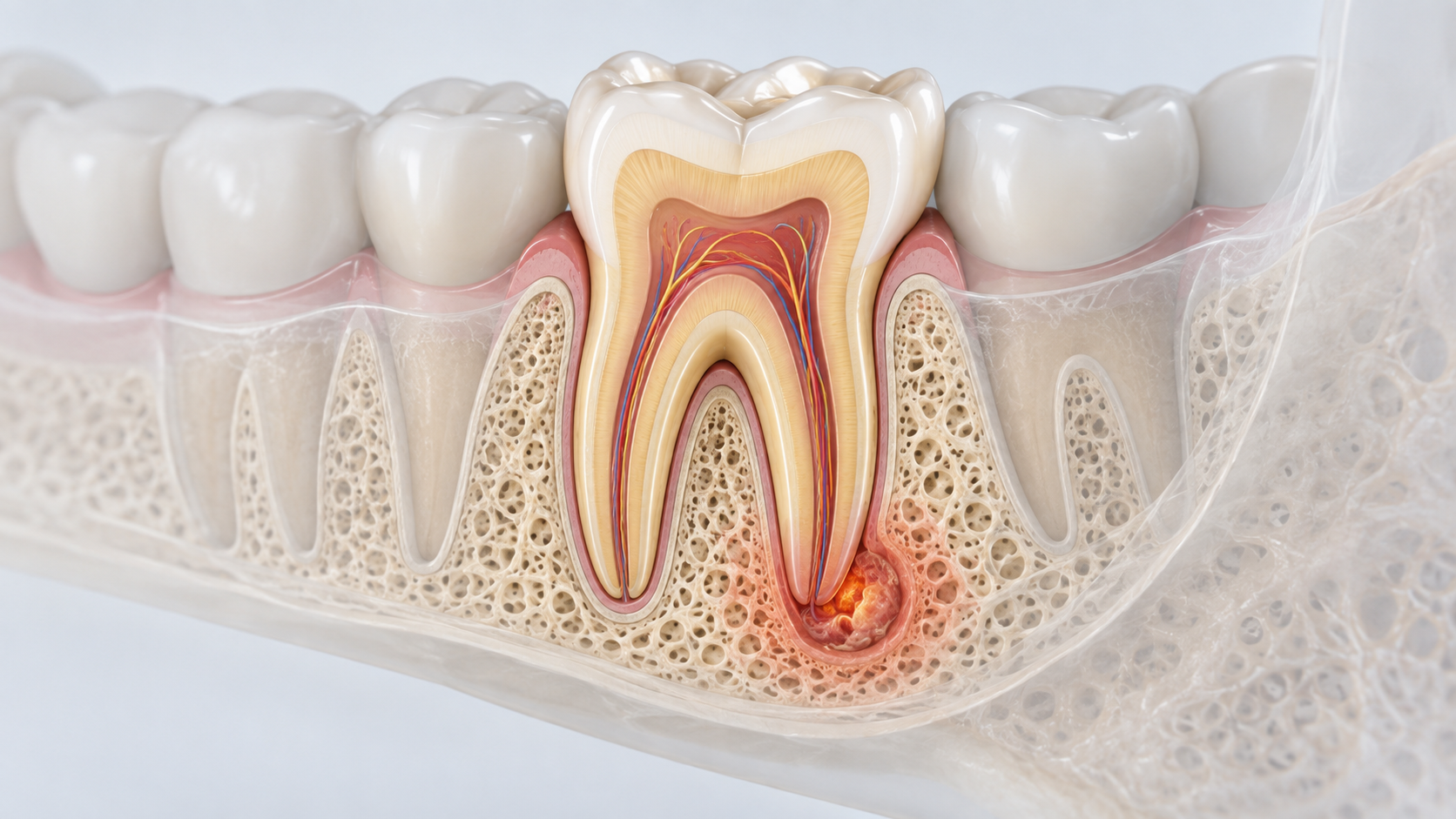
Key points in one minute
The key point: the source is assessed in the tooth and surrounding tissues before a treatment plan is chosen
- Apical periodontitis describes inflammation around the root tip; its cause and form need an in-person assessment.
- Biting pain, a sense that a tooth is high, swelling, discharge or a bad taste are reasons not to postpone a dental visit.
- Diagnosis combines history, examination, tests and, when indicated, a focused X-ray; one observation cannot confirm it.
- Root-canal treatment or retreatment and restoration are commonly discussed; if a tooth cannot be predictably restored, other options are considered.
- Rapidly increasing facial or neck swelling, fever with feeling unwell, or difficulty breathing or swallowing require urgent in-person care.
What apical periodontitis means
The periodontium is the group of tissues that holds a tooth root in bone. When irritants from a root canal reach the tip area, the body can respond with inflammation. A common pathway is deep decay followed by irreversible damage or death of the pulp inside the tooth. A crack, trauma, a leaking old restoration or recurrent infection in a previously treated canal can also be relevant.
The term alone does not determine urgency or treatment. An acute episode may bring marked tenderness and swelling, while a chronic condition can have few symptoms and appear on a review X-ray. Similar sensations may come from a neighbouring tooth, a crack, gum disease or a non-dental source.
Symptoms and signs worth discussing promptly
Arrange a prompt visit for biting pain or pressure, tenderness to tapping, a changed bite, local swelling, a gum pimple, discharge, an unpleasant taste or repeated pain episodes. No pain does not rule out a problem, and pain that suddenly stops does not prove recovery.
Rapidly increasing swelling of the face, mouth or neck, fever with significant malaise, restricted mouth opening, or trouble breathing, speaking or swallowing is not a routine-appointment situation. Seek urgent in-person medical care through the appropriate local service.
| What you notice | Why it matters | A sensible next step |
|---|---|---|
| Biting pain or swelling | Inflammation around a root and other causes need to be ruled out | Arrange an in-person examination |
| Gum pimple, discharge or bad taste | This can indicate a draining infection | Do not open it yourself; contact a dentist |
| Swelling with fever or breathing/swallowing difficulty | There may be a serious spreading infection | Seek urgent care |
How a diagnosis is made
At an appointment, the dentist asks about pain, trauma and previous treatment; examines the tooth, restorations and gum; checks responses to diagnostic stimuli; and gently assesses tenderness to tapping and biting. A focused dental X-ray may be indicated to assess decay, previous treatment, roots and surrounding bone.
No test stands alone. The clinician also considers adjacent teeth, whether the visible part can be restored, cracks, hygiene and overall health. Mention pregnancy, chronic conditions, allergies and every medicine you use, because these can affect a safe plan.
- Which tooth and tissues are considered the source of symptoms?
- Can this tooth be preserved and restored reliably?
- Is imaging needed now and what can it clarify?
- Which post-treatment signs require an earlier call?
Treatment, retreatment and follow-up
Treatment aims to remove the source of inflammation and preserve a tooth when that is predictable. In initial endodontic treatment, the clinician accesses, cleans and treats the root canals, seals them and plans restoration of the visible tooth. The number of stages depends on anatomy, the starting condition, symptoms and the need for interim review.
If a previously treated tooth still has a source of infection, retreatment may be discussed. A crown, post or root anatomy can make access difficult; after assessment, a surgical approach to the root tip or removal with a replacement plan may be considered. These are options, not a universal sequence. Healing and outcome are reviewed clinically and with follow-up imaging, so no outcome can be guaranteed in advance.
| Situation | Possible approach | What to ask |
|---|---|---|
| The tooth has not been treated and can be restored | Root-canal treatment and protection of the visible tooth | How will the tooth be restored and monitored? |
| Previous root-canal treatment did not resolve the problem | Retreatment if access and outlook are acceptable | What obstacles and alternatives are there? |
| The tooth cannot be restored reliably | Removal and an individual replacement plan | Which consequences, timing and options fit my case? |
Before a visit and reducing risk
Before assessment, continue gentle oral hygiene, avoid obvious triggering load and tell the practice about pain, swelling and fever. Do not heat swelling, open the gum or place harsh substances on the tooth or gum. Do not self-start antibiotics: for most local pulpal and periapical conditions they do not replace treating the source in the tooth. A clinician decides whether they are appropriate, considering severity and overall health.
These situations cannot always be prevented, but regular brushing with fluoride toothpaste, cleaning between teeth, moderating free sugars and preventive check-ups can reduce the risk of caries complications. Treating decay early is usually simpler than treating its complications. These are general measures, not a promise of a particular result.
Useful questions at a consultation
Ask for the diagnosis in plain language: what is happening in the canals and around the root, why a particular method is proposed and how the tooth will be restored afterwards. If you are travelling to Yerevan from another city or country, discuss possible follow-up visits and what to do if symptoms change after you leave.
Do not choose a method only from a description, price or one X-ray. The decision depends on examination, anatomy, restorability, surrounding tissues and general health. An in-person consultation can compare preservation, retreatment, a surgical route and replacement when it is genuinely needed.
- What is the pulpal and root-tip diagnosis?
- Why is initial treatment, retreatment or another route proposed?
- What follow-up is needed and what requires an early call?
- Which alternatives are realistic if the tooth has a limited outlook?
Save before your visit
Questions worth asking your dentist
- Can biting pain diagnose periodontitis at home?
- Why are examination, tests and sometimes imaging all needed?
- When might retreatment or a surgical approach be discussed?
- Why does an antibiotic not replace treating the source in a tooth?
Sources
- Antibiotics for Dental Pain and Swelling Guideline — American Dental Association
- Toothache — NHS
- Oral health — World Health Organization


