
 23 Tumanyan St, Yerevan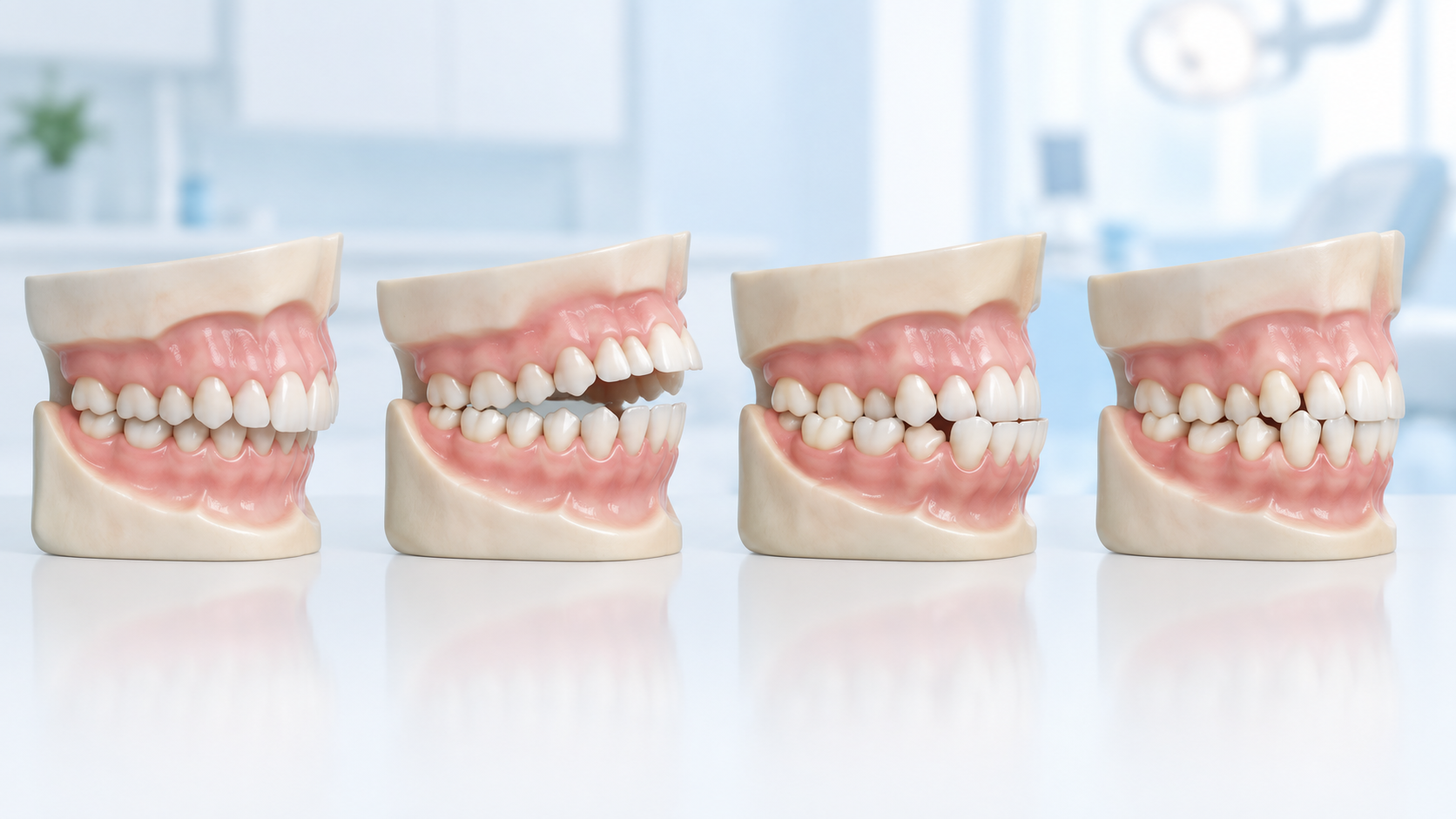
Key points in one minute
The main point: bite type and correction plan require an in-person assessment
- Malocclusion means a variation in tooth position or jaw relationship; it is not a remote diagnosis and does not call for the same intervention in every case.
- Deep bite, open bite, overjet-related distal and mesial relationships, crossbite and crowding describe different signs, and more than one may be present.
- An orthodontist assesses the face, teeth, gums, bite and function, and uses images, photographs or digital models only when they are clinically useful.
- Braces, aligners, observation, treatment of contributing problems and, in selected complex cases, joint surgical planning are options after diagnosis, not interchangeable promises.
What malocclusion means
A bite is the way upper and lower teeth meet when the mouth closes. The term malocclusion groups together variations in the position of teeth, dental arches and jaws. It is not one diagnosis, and it does not by itself tell us how important a finding is for one person. Assessment depends on symptoms, function, tissue health and the patient's goals.
In everyday language, a bite problem is often reduced to visibly uneven teeth. Yet teeth may appear straight while the way they meet still needs observation; the reverse can also be true. The World Health Organization notes that irregular tooth and jaw relationships can affect chewing, speech and appearance. This article can help you prepare for a conversation with a clinician, but cannot replace it.
Children and adolescents are still developing, so timing of assessment matters. Adults can also have a plan, but it is made with the gums, teeth, restorations, implants and other health factors in mind. The same label does not mean the same approach at every age.
Common types and signs
Occlusion classes describe relationships between dental arches, but they do not replace a full diagnosis. In a deep bite, upper front teeth overlap the lower front teeth excessively; in an open bite, a gap remains between some teeth when the jaws close. In a distal relationship, the lower jaw or lower dental arch is relatively further back; in a mesial relationship, it is relatively further forward. In a crossbite, some upper teeth meet inside the lower teeth.
Crowding, gaps, rotations, protruding front teeth and asymmetry can also be part of the picture. They may occur together and alongside different jaw relationships. This is why a name found in a search result should not be turned into a self-diagnosis.
Reasons to arrange a consultation include difficulty biting or chewing, frequent cheek or tongue biting, noticeable wear, discomfort on closing, difficulty cleaning crowded areas, or questions about a child's dental development. No pain does not prove there is no relevant feature, and pain does not prove that the bite is its cause.
| Term | What it usually describes | Why an in-person assessment matters |
|---|---|---|
| Deep bite | Marked vertical overlap of lower front teeth by upper front teeth. | Teeth, tissues and the way the bite closes must be assessed, not just the smile. |
| Open bite | A gap on closing in the front or back part of the bite. | Its causes and functional significance can differ. |
| Crossbite | An atypical side-to-side relationship of one or more groups of teeth. | The clinician checks whether teeth, jaws or function are involved. |
| Distal or mesial relationship | A lower arch or jaw that sits relatively back or forward. | Growth, profile, tooth contacts and correction choices need assessment. |
Causes and factors a clinician considers
Bite development can be influenced by inherited features of tooth and jaw size or position, eruption patterns, early loss of baby teeth, tooth decay, injury and other dental factors. For a growing child, a clinician may also ask about habits and breathing, because some can alter pressure on the dental arches. One factor alone cannot reliably explain a particular person's bite.
Prevention does not mean that every feature can be completely prevented at home. Regular dental visits, treating decay, looking after baby teeth, good hygiene and timely discussion of concerning habits are useful. WHO recommends daily brushing with fluoride toothpaste and limiting frequent free-sugar intake as part of general oral-health prevention.
Do not use homemade aligners, elastic bands, so-called tooth-straightening devices or social-media advice. Uncontrolled force can harm teeth and supporting tissues. If someone is already in orthodontic treatment, any appliance changes should be agreed with their own clinician.
How diagnosis is carried out
At a consultation, an orthodontist listens to symptoms and goals, examines the face, teeth and gums, and assesses contacts, jaw movement and hygiene. Depending on the situation, photographs, a digital scan or models and radiographic imaging may be useful. These are not formalities: they are used when the information is needed for a safe plan.
Before active correction, decay, gum inflammation and other conditions that could complicate treatment should be identified and stabilised. The clinician discusses achievable goals, limits related to anatomy and tissue health, likely review visits and options worth comparing. In Armenia, medical care and services are subject to licensing; when choosing a clinic, you can ask directly about the team's qualifications, assessment and follow-up plan.
Bring a list of questions rather than a demand for a particular appliance. Ask for the diagnosis in plain language, what evidence supports it, what alternatives exist and what may happen if active treatment is deferred.
- How does the clinician describe my bite, and which findings matter in my situation?
- Do I need imaging, a scan or another specialist's opinion, and why?
- What needs treatment or stabilisation before an orthodontic phase?
- What are the options, their limits, the review schedule and retention plan?
Correction options and their limits
Management can include observation, prevention and treatment of related problems, orthodontic appliances or a combination of methods. Braces and aligners are tools for planned tooth movement; neither is automatically better for everyone. The choice depends on the diagnosis, movement complexity, gum and tooth health, expected participation and the monitoring plan.
For substantial skeletal differences, a clinician may discuss care alongside an oral and maxillofacial surgeon. That does not mean surgery is needed for everyone: a decision follows full assessment, explanation of risks and alternatives. Orthodontic treatment is also not a stand-alone cure for every headache, jaw click or jaw pain, because these symptoms can have different causes.
Timing and outcome are individual. They are affected by the starting situation, tissue response, following recommendations, appliance condition and any additional stages. After active movement, a retention stage is often needed to help maintain the achieved position. Do not expect a guaranteed perfect result or stop retention without discussing it with your orthodontist.
What you can do now and when urgent care is needed
Before a consultation, maintain careful routine hygiene, follow your dentist's plan for decay, avoid homemade orthodontic devices and note your symptoms: when discomfort appears, what makes chewing difficult and whether soft tissues are being bitten. This gives the clinician useful starting information. Do not try to exercise a painful jaw or move teeth yourself.
Arrange a routine visit for concerns about bite development, crowding, visible asymmetry, cleaning difficulties or function. Seek urgent medical help under local arrangements for rapidly increasing face or neck swelling, trouble breathing or swallowing, fever with worsening illness, or major injury to teeth or jaw. These signs require in-person assessment and are not home orthodontics.
If you live in Yerevan, visit from another city or travel from abroad, discuss the ability to attend regular reviews before starting. Monitoring and retention are as much part of treatment as choosing an appliance.
Save before your visit
Questions worth asking your dentist
- What specific bite relationship does the clinician identify, and what supports that conclusion?
- Which goals are realistic, what limits apply, and do my teeth or gums need care before starting?
- Why is a particular method recommended in my case, and are there reasonable alternatives?
- How will follow-up and retention be organised after the active phase?
Sources
- Oral health — World Health Organization
- Malocclusion in orthodontics and oral health — FDI World Dental Federation
- Orthodontic treatment methods — American Association of Orthodontists
- Medical care and service licence — Ministry of Health of the Republic of Armenia


