
 23 Tumanyan St, Yerevan
Key points in one minute
Key points for your decision
- The planned implant position and the shape of the bone defect guide the decision.
- Small defects can sometimes be treated during implant placement; larger defects may need separate stages.
- Bone healing takes months and needs reassessment before the next treatment stage.
What bone grafting is intended to achieve
The ridge that once supported a tooth can shrink after tooth loss. Having no pain does not prove that enough bone remains, and a visible hollow in the gum does not by itself establish a need for surgery. The dentist compares the available bone with the planned crown position and the ability to keep the restoration clean. The aim is a workable foundation for the restoration, rather than a larger measurement on a scan.
If an implant would fit only at an unsuitable angle or too close to nearby structures, the plan needs reconsideration. Ridge width and height, soft tissues, nerves and the sinus all matter. These cannot be assessed reliably from a photograph of your smile.
Different defects require different solutions
A horizontal defect means the ridge is too narrow; a vertical defect means that height is lacking. A local missing wall beside a planned implant differs from extensive ridge loss. Remaining bone walls help contain a graft, whereas a large open defect is harder to stabilise. Procedures sharing the same name may differ considerably in complexity.
In the upper back jaw, a sinus lift may be discussed to create more available bone height beneath the sinus. This addresses a particular anatomical problem and is not part of every implant procedure. Preserving an extraction socket also does not guarantee that further grafting will never be needed.
Assessment before surgery
Planning starts with an examination of the bite, gums and oral hygiene. Imaging should answer a clinical question; the dentist may justify a cone-beam CT scan when three-dimensional assessment is needed. The team also considers whether soft tissues can cover and protect the surgical site.
Tell the team about smoking, diabetes, previous jaw radiotherapy, osteoporosis medicines and all other medication. These are factors for individual assessment, not a list of automatic exclusions. Do not stop prescribed treatment yourself. Active inflammation or poor oral hygiene may require preparation and postponement of surgery.
Your own bone, substitutes and membranes
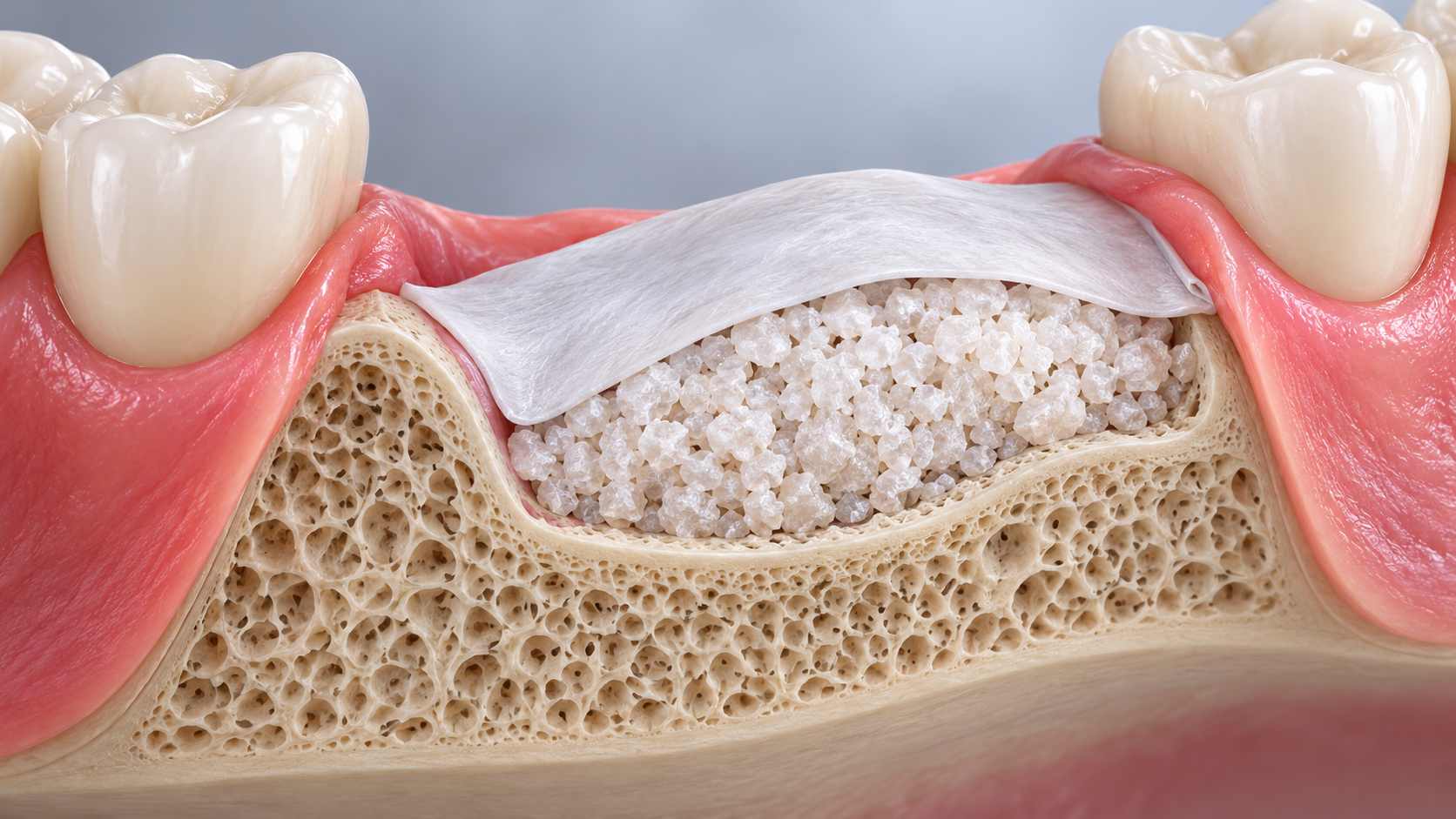
Autogenous bone comes from your own body and can be used as particles or a block. Harvesting it creates an additional surgical site. Processed human-derived, animal-derived and synthetic substitutes are other options. Their properties and remodelling differ, and mixtures may suit particular defects. No single material is best for every person.
In guided bone regeneration, a barrier membrane separates the healing area from soft tissue and helps preserve space. Resorbable membranes usually do not need a separate removal procedure; non-resorbable membranes require a removal plan. Pins, screws or other methods may stabilise the graft or membrane. A brand name cannot replace an explanation of the indication, origin and limitations.
At implant placement or as a separate stage?
Simultaneous grafting may be considered when the implant can be stable in the existing bone and the regeneration site can be protected. With a larger deficiency, the ridge may be rebuilt first, followed by reassessment after healing. The convenience of one appointment should not override the anatomical requirements.
The pathway generally involves preparation, surgery, early wound checks, maturation and reassessment. Graft healing does not automatically mean that a crown is ready to bear load. Findings at review may change the plan or show that further grafting is needed. Ask what each stage covers and which changes could affect the written estimate.
Why an exact completion date cannot be promised
Gum wounds and bone do not heal at the same speed. Waiting is measured in months and varies with defect size, material, blood supply and the person’s health. Hospital information sheets describe different intervals; none should be treated as your own timetable without assessment. The disappearance of swelling does not confirm bone maturity.
If you are travelling to Yerevan from abroad, arrange follow-up as well as the operation. Before booking travel, agree an approximate schedule, a contact for complications and a way to share records with a dentist where you live. Several biological healing stages cannot reliably be compressed into a short holiday.
Alternatives and their limitations
Depending on the situation, options may include a different implant length or diameter, a revised restoration design, a bridge or a removable denture. Avoiding grafting depends on anatomy and loading. A shorter implant is not a universal substitute, and avoiding surgery still involves trade-offs.
Compare the whole pathway: operations, duration, maintenance, effects on neighbouring teeth and what happens if treatment fails. A second opinion using the same scans can help when the reasoning remains unclear. Neither grafting nor an alternative can guarantee an outcome.
Recovery, complications and warning signs
Soreness, swelling, bruising and slight oozing can occur early on; their course and your surgeon’s instructions matter. Complications can include infection, wound opening, membrane exposure, partial graft loss or insufficient new bone. Depending on the surgical site, altered sensation and risks to nearby anatomical structures also need discussion.
Contact the surgeon promptly for worsening pain or swelling, fever, pus, a bad taste with deteriorating symptoms, an open wound or persistent bleeding. Rapidly spreading swelling with difficulty breathing or swallowing needs emergency help. Do not push a membrane back into place or remove graft particles yourself.
What to put in the written plan
Follow your individual instructions on food, cleaning and activity. Avoid pressure on the surgical area and do not probe the wound with a finger. Medicines and mouth care must be agreed with the treating clinician; a general article cannot select an antibiotic or dose. Stopping smoking and attending reviews help reduce complication risks.
Before consenting, ask for the purpose of surgery, material origin, membrane removal needs, treatment stages, alternatives and the response to failure to be documented. Clarify how readiness for an implant will be assessed and who handles urgent concerns. This is general educational information, with no individual patient story or claimed physician review.
Save before your visit
Questions worth asking your dentist
- What defect is present, and can you show it on my scan?
- Why choose this graft material, and will the membrane need removal?
- What alternatives could avoid bone grafting?
- Who will arrange follow-up if I leave Armenia?
Sources
- Cambridge University Hospitals — Cambridge University Hospitals
- International Team for Implantology — International Team for Implantology
- Guy’s and St Thomas’ NHS Foundation Trust — Guy’s and St Thomas’ NHS Foundation Trust


