
 23 Tumanyan St, Yerevan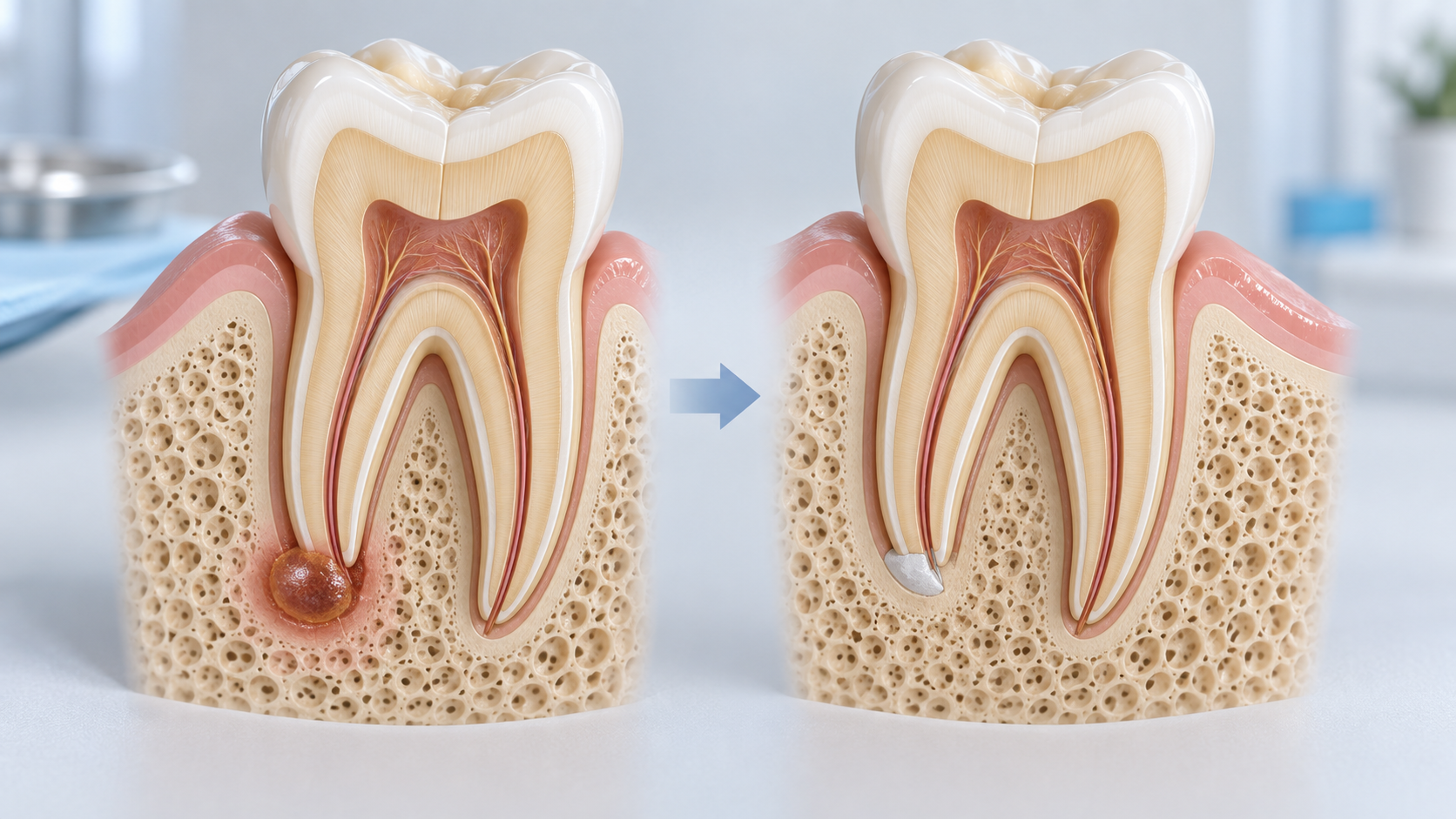
Key points in one minute
Key point: imaging can identify an area of concern, but an in-person assessment guides the decision
- A granuloma and a cyst are distinct histological processes that may look alike on an X-ray.
- Pain on biting, swelling, a draining sinus or a recurring bad taste warrant a prompt dental assessment.
- When a tooth is restorable, root canal treatment or retreatment is often considered before surgery.
- Histology can matter when tissue is removed, healing does not occur as expected, or the finding is atypical.
- Facial or neck swelling with breathing or swallowing difficulty, fever and worsening illness requires urgent in-person care.
What a cyst or granuloma near a root can mean
Root canals contain dental pulp. Deep decay, a crack, trauma or reinfection after earlier treatment can damage or kill this tissue. Irritants may then reach the root tip and trigger an inflammatory response in the surrounding tissues, known as apical periodontitis.
A granuloma is granulation tissue, whereas a cyst has a cavity lined by epithelium. Both may appear as a dark area near the root tip. Lesion size does not settle the question either. The American Association of Endodontists notes that without a biopsy, such a finding is generally only a provisional diagnosis of apical periodontitis.
Symptoms that should not be ignored
A chronic lesion may cause no pain and be found at a routine visit. At other times, pain or pressure on biting, gum swelling, a draining spot, discharge, a bad taste or a feeling that a tooth meets first can occur. These observations do not prove a cyst or granuloma; a crack, gum condition or neighbouring tooth can feel similar.
Do not wait for a routine appointment if swelling is rapidly increasing in the face, mouth or neck, or if fever with marked illness, limited mouth opening, difficulty breathing or swallowing occurs. Seek urgent in-person medical care through the appropriate local service.
| What you notice | Why it matters | Next step |
|---|---|---|
| Pain on biting or local swelling | Inflammation around a root and other causes need assessment | Arrange a dental visit |
| A draining spot or discharge | A lesion may be draining | Do not lance it; seek dental care |
| Swelling with systemic symptoms | A spreading infection is possible | Seek urgent care |
How the cause is assessed
At an appointment, the clinician asks about pain, trauma and earlier treatment, examines the tooth and gums, compares nearby teeth, performs diagnostic tests and uses a periapical X-ray when indicated. In selected cases, three-dimensional imaging may be considered; it does not replace clinical assessment.
The clinician also considers cracks, previous restorations, periodontal health, whether the visible tooth can be restored and overall health. Share pregnancy, allergies, chronic conditions and all medicines because they may affect a safe plan. In Armenia, medical care is provided by licensed organisations and individual entrepreneurs; patients can still ask how the treatment and follow-up will be organised.
- Which tooth is considered the source, and what supports that conclusion?
- Can the tooth be reliably restored after root canal treatment?
- Would additional imaging change the decision in my case?
- Which post-treatment changes need early contact?
Root canal treatment, surgery and alternatives
The aim is to remove the source of inflammation and retain the tooth when that is realistic. During initial root canal treatment or retreatment, the clinician cleans, disinfects and seals the canal system, then plans protection of the visible tooth. Visits, materials and timing depend on anatomy, symptoms and restorability, so there is no universal sequence.
When access is limited, a problem remains after appropriate treatment or tissue needs examination, root-end surgery and removal of the lesion, including cystectomy where indicated, may be discussed. Extraction followed by an individual replacement plan is an alternative when the tooth cannot be predictably retained. Bone healing is assessed over time with clinical review and imaging; a specific outcome or timeline cannot be promised in advance.
| Situation | Possible approach | Useful question |
|---|---|---|
| Restorable tooth with accessible canals | Root canal treatment and restoration | How will the tooth be protected and reviewed? |
| Previously treated tooth with a persistent lesion | Retreatment or a surgical approach | What are the access limits, risks and alternatives? |
| Tooth cannot be reliably restored | Extraction and an individual replacement plan | Which timelines and options fit my situation? |
Before the visit, recovery and prevention
Before assessment, continue gentle oral hygiene, avoid obvious pressure on the painful tooth and tell the clinic about pain, swelling or fever. Do not apply heat, puncture gum tissue or place caustic substances on the area. Antibiotics do not remove a source inside a tooth and should not be started from an article; a clinician decides whether they are needed.
Fluoride toothpaste, cleaning between teeth, limiting frequent free sugars and preventive visits can reduce the risk of decay complications. They do not guarantee that disease will never occur, but they can help identify problems earlier. Follow the personalised aftercare plan and attend agreed review appointments.
Questions to take to the consultation
Ask for a plain-language explanation of the image, how the source of symptoms was confirmed, whether the tooth can be restored and why a particular option is proposed. If you are travelling to Yerevan from another city or country, discuss possible visits, follow-up and whom to contact if symptoms change after you leave.
Do not choose treatment from a label in a report, one X-ray or price alone. The decision depends on the clinical picture, anatomy, surrounding tissues and overall health. With pain, inflammation or uncertainty, arrange an in-person consultation to compare realistic options and their limits.
- Could histology be useful in this case?
- What is the outlook for retaining this particular tooth?
- How will healing be monitored?
- What are the alternatives if the prognosis is limited?
Save before your visit
Questions worth asking your dentist
- Can an X-ray distinguish a cyst from a granuloma with certainty?
- Why is root canal treatment often considered before surgery?
- When should I contact the clinician after treatment?
- Why should antibiotics not be self-started?
Sources
- A Concise Guide to Pathology within Endodontics — American Association of Endodontists
- Updating Diagnostic Terminology in Endodontics — European Society of Endodontology
- Medical care licensing application — Republic of Armenia e-Government


