
 23 Tumanyan St, Yerevan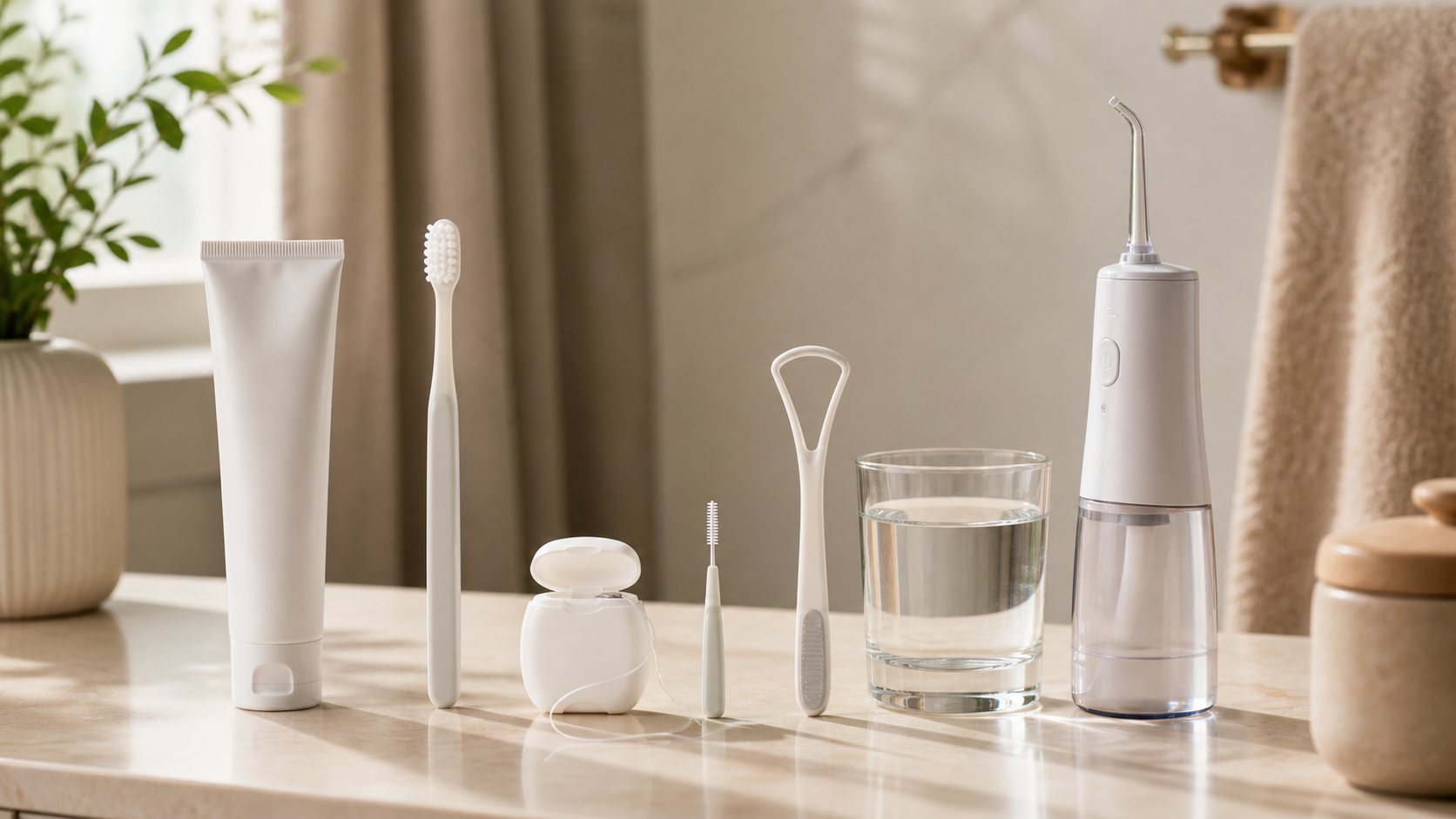
Key points in one minute
The main thing: regular gentle cleaning is more important than the amount of products, and the symptoms of inflammation require an in-person assessment
- Brush your teeth twice a day with fluoride toothpaste; the bristles are directed towards the gum line and moved gently, without aggressive horizontal friction.
- The spaces between the teeth are cleaned regularly: floss, interdental brush, floss holder or irrigator are chosen according to access and the recommendation of a specialist.
- An irrigator can be a useful addition, but is not a universal replacement for brushing and mechanical cleaning of contact surfaces.
- Tartar cannot be removed at home; pain, increasing swelling, pus, temperature, difficulty swallowing or breathing require timely medical attention.
Short answer: what does daily care consist of?
A practical plan starts not with an expensive device, but with a sustainable habit. In the morning and before bedtime, clean all surfaces of the teeth with fluoride-containing paste; then they regularly clean the spaces between the teeth with a product that passes without injury and which a person really knows how to use. The tongue can be cleaned gently if it does not cause pain or damage to the mucous membrane.
Plaque is a soft bacterial film. If not removed, it is associated with tooth decay and gum disease. Hardened plaque, or tartar, cannot be removed with a home brush: attempts to scrape it off with sharp objects can injure tissue and do not replace professional hygiene.
Brush, paste and interdental products: how to choose the working minimum
The brush is not chosen according to color or according to the promises on the packaging. For many people, soft or other bristles recommended by a doctor are comfortable; it is more important that the head allows you to reach the distant teeth. The bristles are placed at the border of the tooth and gums and clean the outer, inner and chewing surfaces with small, gentle movements. There is no need to turn cleaning into intensive “sawing” from side to side.
Fluoride in the toothpaste helps protect enamel from caries; a specific product and additional active ingredients are selected taking into account age, sensitivity, risk of caries, condition of the mucous membrane and recommendations of a specialist. Whitening paste, rinse or gadget does not treat caries, periodontitis or the cause of bleeding.
For contact between teeth, floss, interdental brushes, holders or special devices are used. The thread is inserted carefully, without sharp pressure on the gums, and the lateral surface of each tooth is cleaned. The size of the brush should not be selected by force: too large can injure tissue, and too small will not clean the space effectively.
| Means | What is it suitable for? | Limitation |
|---|---|---|
| Brush and fluoride paste | Remove plaque from accessible tooth surfaces and at the gum line daily. | Does not clean all narrow contacts between teeth and does not remove tartar. |
| Thread or thread holder | Clean tight interdental contacts using proper technique. | Requires accuracy; do not press the floss sharply into the gum. |
| Interdental brush | Clean accessible spaces, including near some structures. | It is better to check the size and method of use with a specialist. |
| Irrigator | Wash away residues and assist in maintenance as a complement to mechanical cleaning. | Does not replace brush, thread or brushes where they are needed. |
Implants, crowns, bridges and removable dentures: an individual route is needed
A crown, bridge, implant or orthodontic device does not make hygiene less important - on the contrary, it changes the areas that need to be cleaned. The space under a bridge, around an implant, or at the edge of a crown may require a stiff-tipped cord, brush, or other tool. There is no universal set for all designs: it is selected after inspection and demonstration of the equipment.
The removable denture is cleaned separately according to the recommendations for its material and stored safely. Do not file the structure or use household glue for repairs. If the closure has changed, mobility, chipping, pain has appeared, or it has become impossible to clean the area, an examination is needed, not self-correction.
- Ask to show the hygiene specific to your design.
- Find out which areas need to be cleaned daily and with what.
- Agree on the frequency of preventive examinations based on individual risk.
- Don't take the absence of pain as evidence that there is nothing wrong around the implant or crown.
Frequent mistakes and situations when you need a doctor
Common mistakes include brushing infrequently, pressing too hard, bypassing the outer teeth, using random products, stopping when there is bleeding, or trying to treat it with mouthwash alone. Bleeding when brushing may accompany gum inflammation; its cause cannot be reliably determined from the article. Do not stop recommended medications or start new medications for your gums without consulting your doctor.
Make an appointment for an in-person examination if you have recurring bleeding, pain, swelling, discharge, ulcers, a bad odor that doesn't go away, sensitivity, tooth mobility, a cracked restoration, or a change in bite. Rapidly increasing swelling of the face or neck, high fever with deterioration of health, difficulty swallowing or breathing are reasons for urgent medical attention according to local regulations.
Save before your visit
Questions worth asking your dentist
- How do I understand that a brush or technique is not suitable for me?
- Is it possible to replace the thread with an irrigator?
- Do you need to clean your tongue every day?
- Why do my gums bleed if I start brushing more thoroughly?
- How to care for a bridge or implant at home?
Sources
- Oral health — World Health Organization
- Oral Hygiene — National Institute of Dental and Craniofacial Research


