
 23 Tumanyan St, Yerevan
Key points in one minute
Key points before your appointment
- Sensitivity toothpaste cannot repair a crack or treat tooth decay.
- A line in the enamel does not automatically mean a deep fracture or a need for a crown.
- Biting pain, lingering sensitivity or a chip needs assessment; swelling with fever needs urgent attention.
Why teeth become sensitive
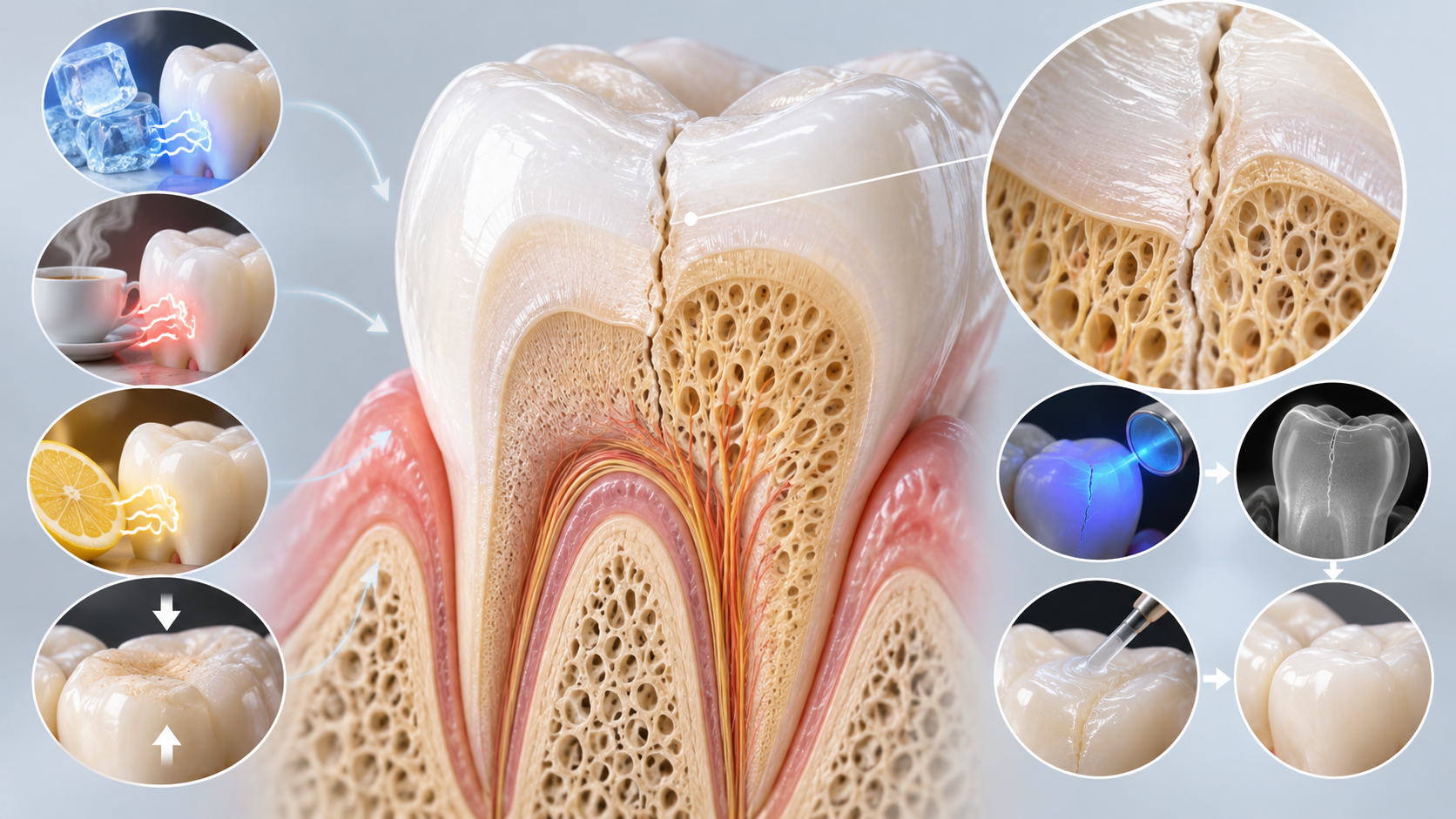
Beneath enamel lies dentine, which contains microscopic tubules. Further inside is the pulp, the tissue containing nerves and blood vessels. Loss of the protective surface or exposure of a root can allow a stimulus to trigger brief, sharp pain. Dentine hypersensitivity is one possible explanation, but decay, a leaking filling and pulp inflammation must first be considered.
Describe the pattern rather than trying to name the diagnosis: which tooth reacts, what triggers it, how long the pain lasts and whether it starts spontaneously. Similar symptoms in neighbouring teeth may have different causes. A photograph cannot reliably establish the depth of a defect or the health of tissue inside the tooth.
Cervical wear, chips and cracks are different
A wedge-shaped cervical lesion is loss of hard tissue near the gum line, usually unrelated to decay. It can be sensitive, but its shape alone does not identify its cause. The dentist considers mechanical wear, acid exposure and other contributing factors. Not every lesion needs an immediate filling: symptoms, progression and the strength of the remaining tooth matter.
A chip means a fragment has broken away, perhaps from an edge or cusp. A crack can exist without any visible missing piece. Shallow lines confined to enamel are often painless, whereas deeper cracks may involve dentine and pulp. A split tooth has separable segments and usually cannot be retained as a complete tooth. A dentist needs to distinguish these conditions.
Risk factors are not a diagnosis
Injury, biting hard objects, large older restorations and excessive forces may contribute to damage. Acid exposure and excessive brushing pressure contribute to surface loss. Discuss grinding or clenching separately: a protective appliance should follow assessment rather than being chosen solely because a tooth reacts to cold.
An assumption that a temperature change cracked the tooth cannot replace an examination. A large filling does not automatically mean extraction is necessary. The outlook depends on the location of the damage, the remaining structure and supporting tissues, rather than pain intensity alone. Being pain-free does not rule out a problem.
What may settle and what needs an appointment
Temporary sensitivity can follow some procedures when it matches the recovery pattern explained by the dentist and gradually improves. There is no single normal duration for every treatment. New, worsening or recurrent pain should not automatically be dismissed as ordinary sensitivity.
Pain when biting or releasing pressure, a lingering response to temperature, spontaneous pain or night pain warrants an examination. None of these symptoms proves a crack on its own. Do not repeatedly test the tooth by biting nuts or ice; provoking pain at home can make damage worse.
| What you notice | Next step |
|---|---|
| Recurring brief sensitivity | Arrange an examination to identify the cause |
| Biting pain or a chip | Prompt examination; reduce loading |
| Swelling, fever or severe pain | Urgent dental assessment |
| Difficulty breathing or swallowing | Emergency medical care |
How the dentist investigates
The assessment begins with symptoms, recent treatment and any injury, followed by examination of teeth, fillings, gums and the bite. Where appropriate, the dentist uses magnification, transillumination, a careful bite test, temperature or other pulp sensibility tests, mobility checks and probing around the tooth. Findings need to be considered together; one test cannot provide the whole answer.
An X-ray can help identify decay, changes around a root and other causes of pain, but a fine crack may not be visible. Cone-beam CT should address a specific clinical question rather than be used for everyone, and it cannot exclude every crack. Sometimes an existing restoration must be removed to investigate further, after discussing the risks and next steps. Remaining uncertainty may require monitoring or an endodontic opinion.
Treatment: protect tissue and address the cause
Confirmed dentine hypersensitivity may be managed with gentler cleaning, desensitising products and professional surface protection. A defect may need sealing or restoration. Contributing wear factors also need attention: replacing a filling without addressing the conditions around it may not resolve the problem.
Repair of a chip depends on its size and the forces on the tooth. Options include reattaching a saved fragment, composite restoration, an onlay or a crown. Covering the cusps of a cracked tooth can help limit movement. If the pulp is affected, the dentist assesses whether it can be preserved or root canal treatment is needed; sensitivity alone is not an automatic reason to remove the pulp.
A root fracture, deep extension or a split can make restoration unpredictable and lead to extraction. Retaining part of a multi-rooted tooth is occasionally considered. A crack does not heal like a broken bone, and neither a crown nor root canal treatment guarantees that it will stop progressing. The plan should explain alternatives, limitations, follow-up and what happens if treatment fails.
Before the visit and after repair
Reduce loading on the affected tooth and avoid hard foods and temperatures that trigger pain. Continue gentle cleaning with a soft toothbrush and fluoride toothpaste. Do not use household glue, file an edge or put a tablet against the gum. A broken fragment can be kept in milk or your own saliva in a clean container and brought to the dentist, who can assess whether reattachment is possible.
After treatment, ask when you can chew on that side, how to clean the repaired area and which symptoms should prompt contact. If a new restoration interferes with closing your teeth or the pain increases, arrange a review. Home care supports treatment but cannot stabilise a structural crack or resolve an infection.
When help is urgent
Severe pain, gum or facial swelling, fever, a pus-like taste or difficulty opening the mouth needs urgent dental assessment. Difficulty breathing or swallowing, rapidly increasing substantial swelling or swelling around an eye requires emergency medical care. Do not wait for a reply to an appointment form.
If you are visiting Yerevan for a limited time, share your departure date and bring previous images. Request a follow-up plan and copies of records: definitive restoration and symptom review may require several visits. This article provides general information, not a diagnosis or medication advice. No human medical review is claimed.
Save before your visit
Questions worth asking your dentist
- What is the likely source of pain, and what else needs to be ruled out?
- Is the defect limited to enamel, or does it involve dentine or pulp?
- Could a less invasive option be tried, and what are its limitations?
- What affects the outlook, and when might extraction become necessary?
- When is follow-up needed, and whom should I contact after travelling home?
Sources
- Sensitive teeth — ADA
- Cracked teeth — AAE
- Chipped, broken or cracked tooth — NHS
- Dental abscess — NHS
- ESE position statement on longitudinal cracks and fractures — ESE
- Preventing tooth wear — DHSC / NHS England


