
 23 Tumanyan St, Yerevan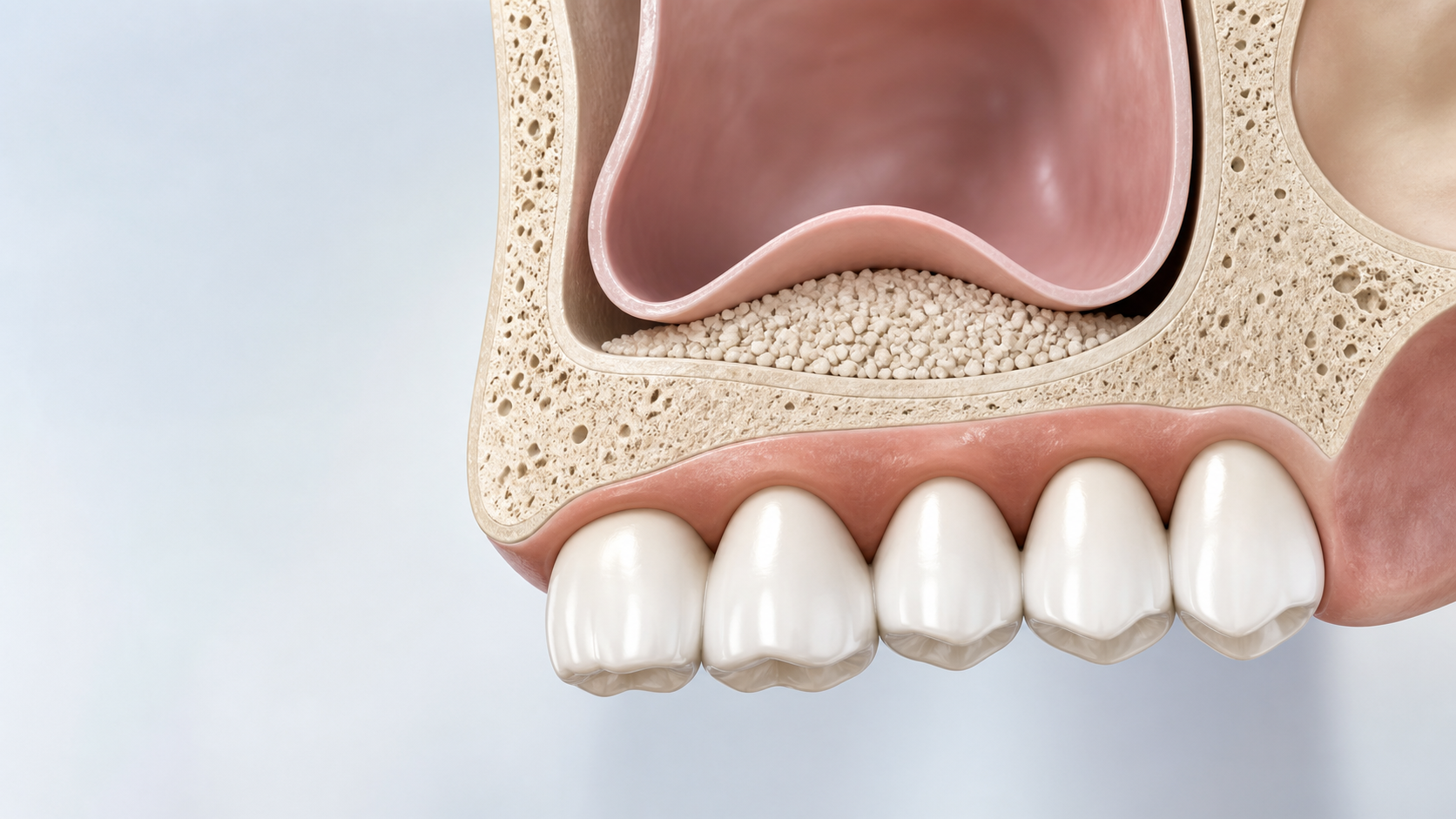
Key points in one minute
Key point: a sinus lift is not a compulsory part of implant treatment, but an individually planned way to increase available bone
- A sinus lift gently elevates the maxillary sinus lining and creates space for bone support in the posterior upper jaw; it does not treat sinus disease.
- Lateral-window and transcrestal approaches are not simply ‘better’ or ‘worse’; the choice depends on anatomy, remaining bone and the surgical plan.
- An in-person assessment and three-dimensional imaging are commonly needed; nasal or sinus symptoms may also call for an ENT opinion.
- Pain and swelling can occur after surgery, but worsening pain, fever, nasal discharge, significant bleeding or breathing difficulty need prompt medical contact.
What a sinus lift is designed to do
Above the roots of the upper back teeth lies the maxillary sinus, an air-filled space lined with a thin membrane. After a tooth is lost, the bone of the upper jaw can shrink and the sinus floor may sit closer to the mouth. If there is not enough available bone to support the chosen implant safely, a surgeon may discuss a sinus lift: the membrane is carefully raised and bone support is allowed to develop in the created space, with or without a material according to the plan.
It is not a way to ‘grow a tooth’ and it is not standard preparation for every implant. Its purpose is to plan support for a future restoration in one specific area. An implant may be placed at the same visit or after healing; in other situations a short implant, a different prosthetic solution or no implant may be appropriate. A realistic outcome is assessed from imaging, healing and follow-up, not from advertising.
Who it may suit and when the plan may change
The procedure is most often discussed for an implant in the premolar or molar region of the upper jaw when imaging shows insufficient bone height for the intended restoration. The clinician considers bone volume, sinus shape and septa, the lining, bite, adjacent teeth, oral hygiene, smoking, long-term conditions and medicines. The same measurement on a scan does not mean the same decision for every person.
Surgery may be postponed or adapted when there is active infection, unexplained nasal or sinus symptoms, inadequate oral hygiene, an uncontrolled health condition, or another dental issue that should be treated first. This is not a self-diagnosis checklist; it shows why a face-to-face assessment matters. If sinus disease is suspected, the surgeon may advise an ENT consultation before treatment.
- What are the height and shape of bone at my implant site on the CBCT scan?
- Are there sinus features or symptoms that need an ENT assessment?
- Will the implant be placed at the same stage or after healing?
- Which alternatives are reasonable in my case?
Assessment and choosing a lateral or transcrestal approach
Planning starts with a conversation and examination. Tell the clinician about nasal and sinus conditions, allergies, smoking, medicines, bleeding disorders, diabetes, pregnancy and previous surgery. The area is usually assessed with dental imaging, often cone-beam CT. It can show remaining bone, sinus boundaries and anatomical features, but does not replace a clinical examination or, where needed, ENT assessment.
With a lateral, often called open, approach, access is made through the side wall of the sinus. With a transcrestal, or closed, approach, the work is performed through the planned implant site. These terms describe the route of access; they do not promise identical speed, comfort or results. International reviews show that the pattern of complications varies with technique and clinical circumstances, so it is sensible to ask why a particular option is proposed.
| Question | Why it matters | What should not be promised |
|---|---|---|
| Remaining bone and sinus anatomy | They help determine access and staging. | That one technique suits everyone. |
| Sinus health and symptoms | They can identify when ENT input is needed. | That a sinus lift treats sinusitis. |
| Material and timing | They follow the implant and healing plan. | An exact rate of bone formation without follow-up. |
| Alternatives | They allow comparison of treatment burden, risks and goals. | That surgery is essential for every missing tooth. |
What happens during surgery and afterwards
The exact steps depend on the approach and the treatment plan. After anaesthesia, the surgeon creates access, carefully separates the sinus membrane from the bony wall and forms a space. Material may be placed there, or another agreed protocol may be used; an implant may be placed at that visit or later. This is not an operation guide: the extent of treatment, anaesthesia, sutures, medicines and timing are determined by the treating team.
Swelling, moderate soreness, a blocked sensation or traces of blood may occur after the procedure; their character and duration differ from person to person. Your clinician should give personalised advice about oral hygiene, food, activity and actions that raise sinus pressure. Do not start antibiotics, pain medicines, decongestants or any other medicines from an article or a friend’s advice; take only what has been prescribed for you.
Risks, limitations and alternatives
Like any surgical procedure, a sinus lift has risks. Research describes sinus membrane perforation, bleeding, wound opening, exposure or loss of material, and sinusitis among possible events. The occurrence of a complication alone cannot predict an individual outcome: its extent, the response, healing and follow-up all matter. Systematic reviews emphasise that prevention and a management plan for complications should be part of treatment planning.
Alternatives may include a different implant size or position, a short implant where suitable, a bridge, a removable solution or leaving the space, depending on function and your goals. Compare options using your diagnostic information, expected load, number of stages, maintenance, risks and the cost quoted separately by the clinic. This article does not replace informed consent.
Preparing for the consultation and monitoring recovery
Before your consultation, gather information about nasal or sinus symptoms, long-term conditions, medicines, allergies and any previous scans. Ask the clinician to show you the site on the imaging and explain the proposed route in plain language: which access is considered, why, whether ENT input is needed, whether the implant is planned the same day and how follow-up will work. You can take time to decide and seek a second opinion if questions remain.
After surgery, follow your surgeon’s personal instructions and scheduled review visits. Do not probe the area with your fingers or change medicine doses yourself. If you have pain, inflammation or uncertainty, do not diagnose it from this article; timely in-person contact with a clinician is safer than waiting or self-treatment.
Save before your visit
Questions worth asking your dentist
- Is there enough bone at my site for an implant without a sinus lift?
- Which approach do you recommend, and which scan findings support it?
- Do I need an ENT consultation before surgery?
- Which symptoms are expected after treatment and which need an unscheduled review?
Sources
- Surgical Techniques and Grafting Protocol for Sinus Floor Elevation — International Team for Implantology
- Complications of sinus floor elevation procedure and management strategies: a systematic review — PubMed
- Law on Medical Care and Service of the Population — ARLIS, Republic of Armenia


