
 23 Tumanyan St, Yerevan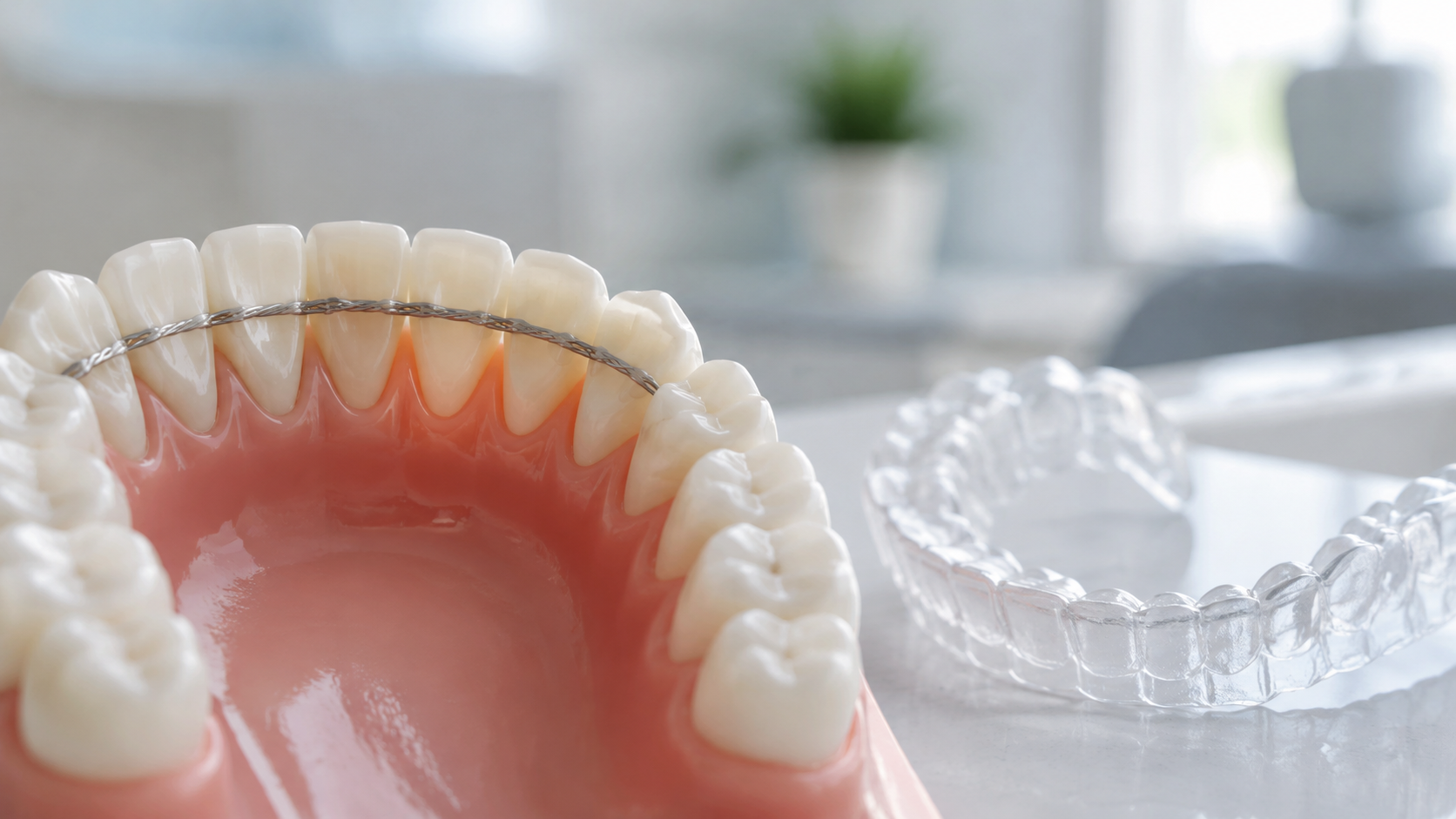
Key points in one minute
The key point: a retainer works best with an individual plan, regular reviews and careful daily care
- Teeth can continue to change throughout life after active orthodontic treatment; a retention plan reduces this risk but cannot promise a permanently unchanged result.
- Clear removable trays, Hawley retainers and fixed wires each have benefits and limits, and an orthodontist may combine them.
- If a tray feels tight, a fixed wire comes loose or teeth seem to move, do not adjust or glue it yourself; contact your orthodontist.
- Cleaning teeth and the area around a fixed retainer, storing trays in a case and attending reviews matter as much as wearing the appliance.
Why retainers matter after braces or aligners
Teeth do not become permanently fixed in place when braces come off or aligner treatment ends. Their position is influenced by tissues around the teeth, contacts with the opposing teeth, lip and tongue pressure, growth and natural changes with age. Retention, the phase of holding the result, is therefore a standard part of orthodontic care. It can reduce the likelihood of noticeable relapse but does not remove the need for follow-up.
The chance and pattern of movement differ from person to person. Starting crowding or spaces, lower incisor position, bite, gum health and following the prescribed schedule can all matter. There is no safe rule that a retainer is needed for only a few months, or that wisdom teeth alone inevitably cause relapse. Wisdom teeth are assessed from their position, symptoms, imaging and the clinician's plan.
| Appliance | What may be useful | What needs attention |
|---|---|---|
| Clear removable tray | Discreet, covers the dental arch and can be removed for eating and brushing | It must be worn as prescribed; it can be lost, distorted or stop fitting |
| Hawley retainer | Durable and often adjustable by a clinician | The wire is visible and the acrylic portion is not comfortable for everyone |
| Fixed retainer | A wire bonded behind the front teeth does not depend on remembering to insert it | Careful cleaning and checks are essential because partial debonding may go unnoticed |
How long to wear a retainer — and why the internet cannot set your schedule
Many plans use longer wear of a removable appliance in the first months after active treatment, then change the schedule. The exact hours, transition to night-time wear and overall duration are set by the orthodontist who can assess tooth contacts and the tissues around them. Do not shorten the schedule simply because teeth look straight: small changes can start before they show in a photo.
Retention is often long term and can include ongoing night-time wear. That does not mean the treatment failed; teeth continue to change after orthodontics. If the schedule is uncomfortable, rubs the mouth, affects speech or disrupts sleep, discuss it at a visit. Your clinician can check the fit, material and bite and suggest a safe adjustment instead of an unsupervised stop.
Daily care for trays, fixed wires and teeth
Rinse a removable retainer in cool water, clean it with a soft brush and the product recommended by your clinician or manufacturer, then dry it and keep it in a rigid case. Hot water, boiling, a hot car and harsh household products can damage or distort the material. Do not wrap a tray in a napkin, as it is easily thrown away. Removable appliances are usually taken out for meals unless your orthodontist has given a different instruction.
A fixed retainer does not replace tooth cleaning. Brush along the gumline and tooth surfaces, then clean under the wire with a suitable interdental brush, floss threader or another method demonstrated by a professional. Bleeding gums, persistent odour, rapid plaque build-up or an area you cannot clean are reasons to arrange a hygiene or orthodontic review, not to remove the wire yourself.
- Keep a removable tray in its labelled case whenever it is not in your mouth.
- Do not trim, bend or force a tray into place at home.
- Bring trays to routine appointments and tell dental professionals about a fixed retainer.
- After a new filling, crown or professional cleaning, check that the appliance still fits and does not change your bite.
A lost or tight tray, a loose wire or tooth movement
A tray that fits without force, does not cause pain and has not changed shape will usually remain usable until the next review. If it suddenly feels tight, presses on one tooth, cracks or no longer seats, do not force it to fit. The reason may be tooth movement, tray distortion or a changed restoration. Take a photo of the appliance and contact your orthodontic team; the urgency depends on the situation, but it is best not to leave it for a long time.
A fixed wire can detach from one tooth, bend or break. Even without pain, some teeth may begin to move. Do not use household glue, pull on it or bite hard food to put it back. If a sharp end irritates the cheek or tongue and a prompt visit is not possible, it can be covered temporarily with orthodontic wax while you arrange professional care.
| Situation | Practical next step | Why |
|---|---|---|
| Tray fits as usual and is undamaged | Continue the prescribed schedule | Routine review is still needed |
| Tray is tight or will not seat | Do not force it; contact the orthodontist | Tooth movement must be distinguished from tray distortion |
| Wire is loose or sharp | Do not glue it; arrange repair | A partly detached retainer may no longer hold a tooth |
| Bite changes, pain or swelling appears | Arrange an in-person dental assessment | The cause may be more than the retainer |
Replacement trays, reviews and wisdom teeth
Removable retainers do not last forever. They can become scratched, crack or fit less accurately after dental work or a bite change. Do not wait until your only tray breaks. At a review, ask whether a spare is appropriate, how to notice wear and when to check the fit. A replacement is decided after an examination or scan, because copying an old distorted tray may not match the current tooth position.
Wisdom teeth are often discussed alongside lower front-tooth crowding, but they do not alone explain every case of relapse. Removing or monitoring them needs a separate assessment of symptoms, position, risk to a neighbouring tooth and indication. Reviews are useful even without complaints: the clinician can check the retainer, cleaning, gums, bite and small changes while they are still easier to identify.
- Keep your orthodontist's contact details and the date of the last review.
- Report a new filling, crown, injury or bite change.
- Do not use a friend's retainer timetable or a universal-retainer advertisement as a plan.
- If you lose a tray, discuss a replacement promptly rather than waiting for visible movement.
When to arrange an earlier appointment
Contact an orthodontist if you notice a new space or tooth rotation, the tray no longer fits, the retainer has detached, a sharp edge has appeared, food repeatedly catches or cleaning has become difficult. Pain on biting, a loose tooth, gum inflammation or a new bite asymmetry should not be dismissed as simply getting used to a retainer. An examination is needed to find the cause.
Seek urgent medical assessment for increasing facial swelling, fever, a dental injury, severe pain, ongoing bleeding, or difficulty breathing or swallowing. A retainer does not treat tooth or gum disease. Helpful questions at a consultation include why this appliance was chosen, what your present schedule is, how to clean it, which signs of failure matter and when the next review should be.
Save before your visit
Questions worth asking your dentist
- Which retainer or combination is suitable for my bite, and why?
- How many hours and until when should I wear my removable tray?
- How should I clean my fixed retainer, and which products should I avoid?
- What should I do if a tray becomes tight or the wire detaches?
Sources
- Orthodontic Retainers: Types, Care, & Life After Braces — American Association of Orthodontists
- Clinical Guidelines: Orthodontic Retention — British Orthodontic Society
- The effectiveness of adjuncts or alternatives to orthodontic retainers: systematic review — PubMed
- Law of the Republic of Armenia on medical care and services for the population — ARLIS


