
 23 Tumanyan St, Yerevan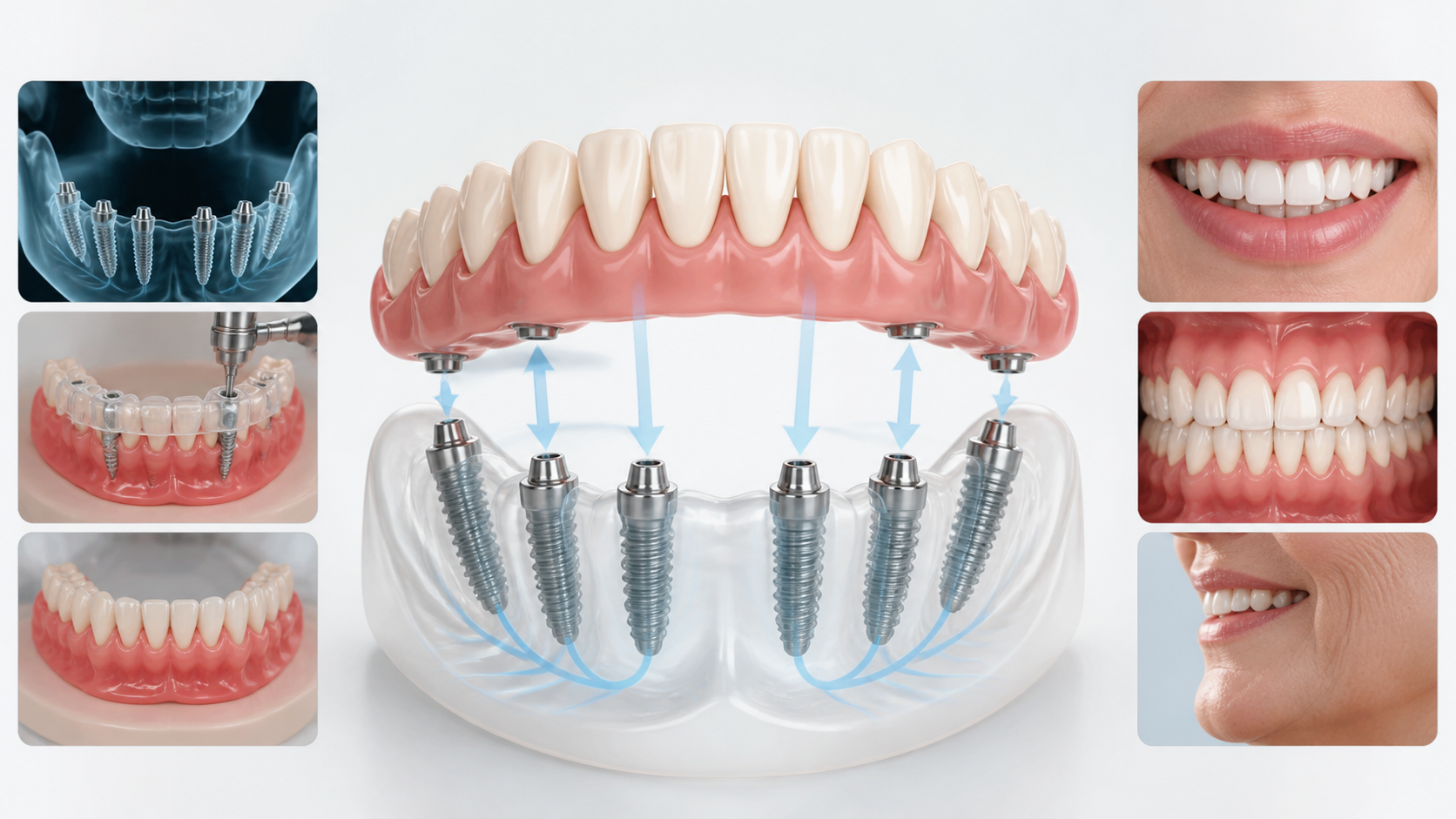
Key points in one minute
The main thing: six implants are an option for complete restoration, not a universal template
- All-on-6 - a complete fixed design on six implants for one jaw; the approach is assessed individually.
- Before treatment, the condition of the bone and gums, bite, remaining teeth, general health, hygiene and follow-up plan are discussed.
- A temporary fixed structure on the day of surgery is only possible under suitable clinical conditions and sufficient primary stability.
- The design requires daily cleaning and monitoring; pain, mobility, chipping or inflammation cannot be corrected on your own.
What is All-on-6 and what problem does it solve?
All-on-6 describes the restoration of all teeth in the upper or lower jaw with a fixed prosthetic arch supported by six implants. Implants are supports in the bone; the prosthesis is fixed to them through the system components. For the patient, the structure is usually not removed independently, but its maintenance by a doctor remains part of the treatment. The goal is to create a functional, hygienic structure, and not just get “teeth in one day.”
Six supports is not a rule that is automatically better or worse than another number of implants. The ITI International Consensus emphasizes that the number, size and distribution of implants are determined by the prosthetic plan, jaw shape and bone volume. Therefore, the same name of the method does not mean the same scheme, material, timing or prognosis for different patients.
Who is suitable and when to choose a different path
The approach may be discussed in cases of complete absence of teeth or when the remaining teeth have a poor prognosis. During the consultation, complaints and expectations, mucous membranes and gums, bite, habit of clenching teeth, quality of hygiene, visualization, chronic diseases and medications are assessed. Smoking, uncontrolled general illness, active inflammation, and inability to be monitored regularly make it difficult to safely promise the same protocol.
Sometimes it makes more sense to save individual teeth, use a different number of implants, perform an osteoplastic stage with delayed loading, or consider an implant-supported removable denture or a conventional complete denture. For patients from Yerevan, other regions of Armenia and those coming from abroad, it is important to discuss in advance the availability of follow-up visits and actions in case of breakdown.
- What teeth and tissues can be saved?
- Are the bone and anatomical conditions sufficient for the planned supports?
- Is it safe to give immediate loading?
- How do hygiene, bruxism, smoking and health change risk?
- Who and how will maintain the structure after treatment?
Diagnosis, stages and temporary design
The plan begins with an in-person examination, assessment of the gums and bite, photographs, impressions or digital scans and x-ray diagnostics to the extent determined by the doctor. It is important to plan not only the implants, but also the position of future teeth, speech, aesthetics, access under the denture for cleaning and load distribution. If the teeth are preserved, the prognosis of each of them is discussed separately.
Stages may include treatment of inflammation, extraction of teeth according to indications, installation of implants, a temporary structure or a healing period, then a permanent prosthesis and monitoring. Immediate temporary construction is not always possible. This option depends, among other factors, on primary implant stability and controlled loading; simultaneous bone grafting or sinus lift may change the decision. This is a clinical judgment and not a commitment associated with the All-on-6 name.
| Stage | Goal | What can change the plan |
|---|---|---|
| Diagnostics | Assess bone, tissue, bite and overall risk. | Inflammation, anatomy, dental prognosis, health. |
| Planning | Determine the position of the supports and the future arc. | Bone volume, aesthetics, access for hygiene. |
| Temporary construction or healing | Protect fabrics and control stress. | Implant stability, occlusion, healing. |
| Permanent prosthesis | Restore function and provide maintenance. | Condition of fabrics, contacts, comfort and wear. |
What results to expect and how to care
A realistic goal is to restore the function and appearance of the full arch within the confines of the specific situation. During the adaptation period, speech, sensation of volume, eating habits and perception of a smile may change. You cannot honestly promise the same timing, feel, number of visits, aesthetics or service life in advance: the result is affected by healing, tissue, design, loading, home hygiene and observation.
The doctor or hygienist shows you how to clean the area under the archwire and around the supports. Depending on the design, a soft brush, interdental brushes, irrigator or special threads can be used; a specific set is selected individually. You should not tighten the parts yourself, file the prosthesis, or glue the broken fragment using household products.
Risks, alternatives and questions for your doctor
Implant treatment is associated with surgical, biological and technical risks: impaired healing, infection, inflammation of the tissue around the implant, loss of integration, anchorage problems, chipping, wear or crack of the prosthesis and overload. Scientific reviews describe good results in the groups studied, but studies vary in patients and protocols; these data do not constitute a personal guarantee.
During the consultation, ask why six implants are proposed, which alternatives exist, whether a temporary fixed restoration is appropriate, how reviews and repairs are arranged, and which signs require prompt attention. Do not choose a protocol or start medication based on an article or image: pain, inflammation or uncertainty requires an in-person assessment by a dental surgeon and prosthodontist.
Save before your visit
Questions worth asking your dentist
- Why are six implants being discussed in my case and not another option?
- What diagnostic data confirm the planned position of the implants?
- Is a temporary permanent structure immediately possible and what conditions are needed for this?
- How to clean a denture and what symptoms require an unscheduled visit?
Sources
- Number of Implants Placed for Complete-Arch Fixed Prostheses — International Team for Implantology
- Loading Protocols for Fixed Prostheses in Edentulous Jaws — International Team for Implantology
- Full-arch implant-supported monolithic zirconia fixed dental prostheses: systematic review — PubMed
- Law of the Republic of Armenia on Licensing — ARLIS


