
 23 Tumanyan St, Yerevan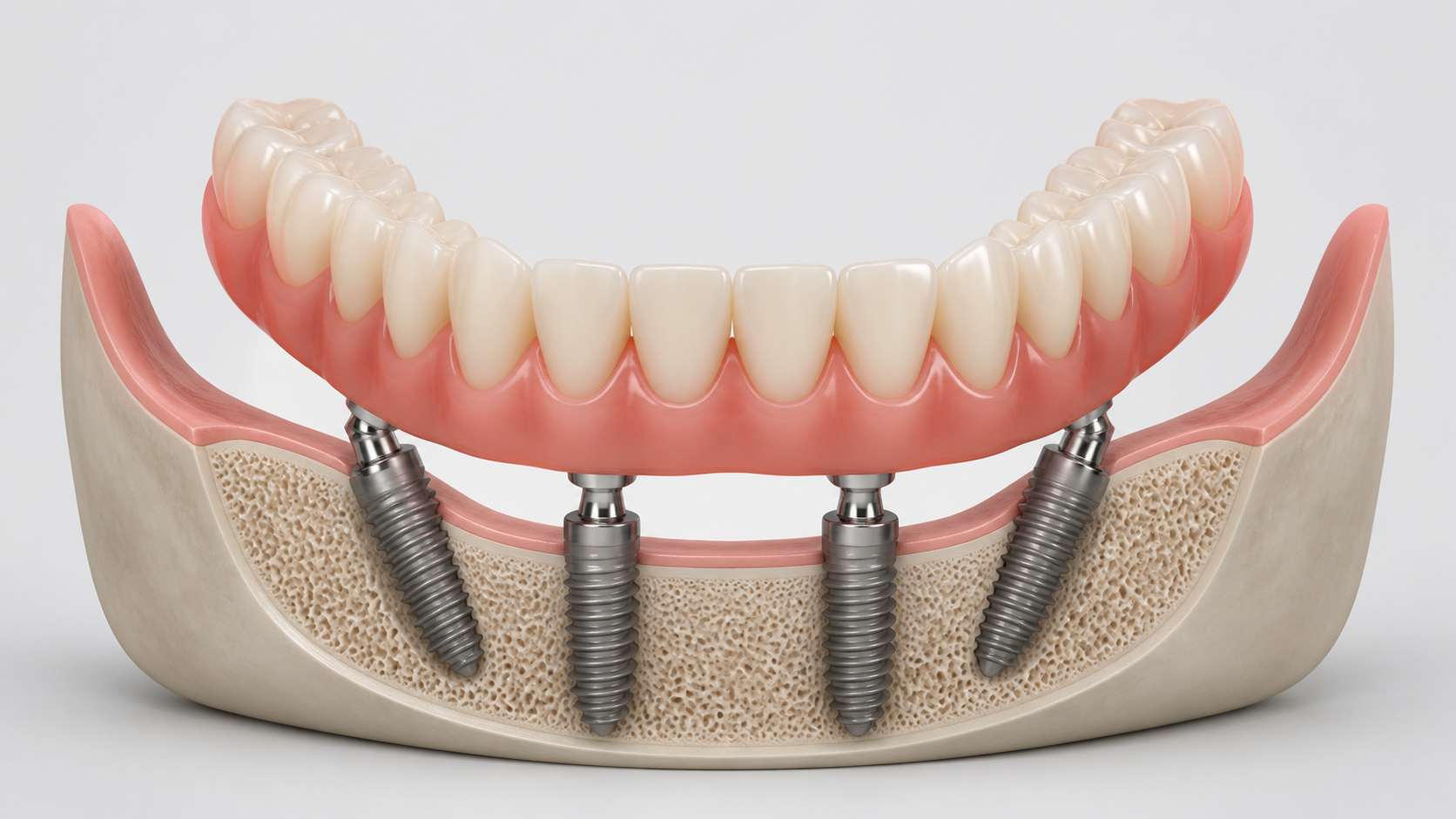
Key points in one minute
The main thing: four implants are not a ready-made answer, but one of the options for complete recovery after diagnosis
- All-on-4 - a protocol for a full fixed design on four implants for one jaw; it does not mean that the same plan is suitable for every person.
- Before treatment, the volume and quality of the bone, the condition of the gums and remaining teeth, bite, photographs, exercise habits, general health and ability to maintain hygiene are assessed.
- Temporary construction on the day of surgery is not possible in all cases: the decision depends on the primary stability of the implants, the loading plan and the clinical situation.
- The structure requires daily cleaning and follow-up visits; inflammation, mobility, chipping, changes in bite or pain cannot be corrected on your own.
What is All-on-4 and what problem does it solve?
All-on-4 is a common name for a complete, permanent prosthetic restoration supported by four implants in the upper or lower jaw. Supporting elements and a prosthetic arch are installed on the implants, which replaces all the teeth of this jaw. Typically, the two anterior implants are positioned more upright, while the two lateral implants can be angled to utilize available bone and bypass important anatomical structures. The specific geometry is not selected according to a template: it is determined by inspection.
The approach is discussed in cases of complete absence of teeth or when the remaining teeth have a poor prognosis and, after clinical assessment, their extraction is planned. Its goal is to restore chewing function and the appearance of the full arch with a fixed structure. The word “non-removable” describes the method of fixation for the patient, but does not replace professional service: the doctor can remove the structure for inspection and repair, if this is provided for by the system and indications.
Who can use this method and who needs a different plan?
The candidate is considered not by age or advertising photograph, but by the totality of data. The doctor clarifies complaints and expectations, evaluates oral tissues, bite, smile, clenching or grinding habits, imaging results, chronic disease status and medications taken. Smoking status, ability to clean the structure, ability to attend follow-up appointments, and realistic expectations of treatment are also important.
Sometimes four supports are not enough or are not the preferred choice: a different number of implants, an osteoplastic stage, delayed loading, a removable implant-supported denture, or another option may be required. Active inflammation, uncontrolled general diseases, poor hygiene, limited follow-up or unfavorable anatomy do not provide a basis for promising immediate permanent results. This is not a “refusal without reason”, but an attempt to choose a safe and serviceable plan.
- Which teeth and tissues can be saved, and which ones have a poor prognosis?
- Are the bone and anatomical conditions sufficient for the planned position of the implants?
- Is it safe to give immediate weight bearing or is it wiser to wait until it heals first?
- How can bruxism, smoking, diabetes, medications and hygiene affect the risk and control plan?
- What option remains if during treatment the situation turns out to be different than in the pictures?
Diagnosis and main stages of treatment
Planning begins with an in-person examination and diagnosis. A gum and bite assessment, photographs and impressions or digital scans, and x-rays are usually needed; the scope of the study is determined by the doctor. If there are still teeth, they discuss separately whether each of them can be saved. The diagnostic model helps plan the position of future teeth, access for cleaning, aesthetics and load distribution - not just the number of implants.
The surgical and prosthetic stages may include tooth extraction as indicated, tissue preparation, implant placement, a temporary restoration or healing period, then fabrication of a permanent prosthesis and monitoring. Immediate provisional construction is only possible under suitable conditions, including sufficient primary stability of the implants; this is a clinical decision on the day of surgery, and not a mandatory part of the name of the method. The permanent design, material, and transition time are selected after assessment of healing and loading.
| Stage | Task | What can change the plan |
|---|---|---|
| Diagnostics | Assess bone, soft tissue, bite, teeth and overall risk. | Inflammation, anatomy, prognosis of remaining teeth, general health factors. |
| Surgical planning | Determine the positions of the implants and the need for additional procedures. | Available bone volume, anatomical structures, tissue quality and stability. |
| Temporary construction or healing | Protect fabrics and control stress. | Primary stability, occlusion, compliance and risk of overload. |
| Permanent prosthesis and observation | Restore function and provide maintenance to the structure. | Healing, aesthetics, contacts, cleanability, wear or complications. |
What result is realistic to expect and how to care
The goal of treatment is a functional full arch that can be safely maintained. Before starting treatment, it is worth discussing what changes in speech, chewing, lip shape, taste and eating habits are possible during the adaptation period. You cannot promise the same appearance, comfort, number of visits or service life in advance: the result is affected by healing, bone and soft tissue conditions, design, loading and adherence to recommendations.
Daily hygiene is as important as surgery. The doctor or hygienist shows how to clean the space under the arch and around the supports: it can be a soft brush, interdental brushes, an irrigator or special threads - the set is selected individually. Follow-up examinations allow you to evaluate the tissue around the implants, bite, attachments and wear. Do not try to twist the elements, file the prosthesis, or glue the broken fragment with household products.
Risks, limitations and alternatives
As with other implant treatments, surgical, biological and technical complications are possible. These include poor healing, infection, inflammation of the tissue around the implant, loss of integration, problems with screws or fixtures, chipping or wear of the veneer, fracture of the prosthesis, and overload. Scientific reviews describe good survival rates in the groups studied, but also indicate heterogeneity among studies and complications; these data cannot be converted into a personal guarantee.
The alternative may be a full design on a different number of implants, a different surgical protocol, bone grafting with delayed treatment, an implant-supported removable denture, or a conventional complete denture. Pros and limitations depend on anatomy, health, budget and willingness to care, but a clinic should not offer a method just because it is popularly called. For patients from Yerevan, other regions of Armenia or coming from abroad, it is useful to agree in advance on a schedule of follow-up visits and an action plan in case of breakdown.
Questions to ask during a consultation
Ask your doctor to explain the diagnosis in clear terms and show what evidence the plan is based on. Find out why exactly four implants are being considered, what alternatives are available, whether a temporary design is possible in your case, what is included in the stages of treatment and how control will be organized. If we are talking about treatment in Armenia during a short trip, it is especially important not to replace remote discussion with a final diagnosis: the final plan may change after an in-person assessment.
The information in the article does not establish a diagnosis and does not replace an examination by a dental surgeon or orthopedist. Do not start medications or change wound or prosthetic care according to the article. If you have pain, inflammation or doubt, schedule an in-person consultation to safely evaluate the situation.
Save before your visit
Questions worth asking your dentist
- Why is All-on-4 being considered in my case and not another full denture option?
- What diagnostic data confirm that implants can be placed in the planned positions?
- Is a temporary permanent structure immediately possible and what conditions must be met?
- How to clean the structure, how often to come for inspection and what symptoms require unscheduled attention?
Sources
- The all-on-four treatment concept: Systematic review — PubMed
- Rehabilitation of edentulous jaws using the All-on-Four treatment concept: overview of systematic reviews — PubMed
- Implant loading protocols for edentulous patients with fixed prostheses — International Team for Implantology
- Law of the Republic of Armenia on Licensing — ARLIS


