
 23 Tumanyan St, Yerevan
Key points in one minute
Before choosing a whitening method
- Natural teeth can be lightened; fillings, veneers and crowns retain their existing colour.
- The cause of darkening and the health of teeth and gums should be assessed first.
- In-office and dentist-supervised home approaches differ in timing and organisation, not in a guaranteed final shade.
- Sensitivity and gum irritation can occur; severe or worsening pain should never be endured for a whiter smile.
Whitening and cleaning do different things
Professional cleaning removes plaque, calculus and some surface stains. Your smile may look lighter afterwards, but that can be a return to its original colour rather than a change to the tooth’s underlying shade. Whitening works differently. Products commonly contain hydrogen peroxide or carbamide peroxide, which alter coloured compounds within tooth tissues. The terms may sound similar, but the procedures address different needs.
Whiteness is not a measure of health. A light-coloured tooth can have decay, while healthy teeth may naturally be cream-coloured. If you want a fresher, well-cared-for appearance, start by discussing hygiene and gum health. Whitening is an elective cosmetic choice; keeping your natural colour is equally valid. It does not correct tooth shape, crowding, a crack or a faulty filling.
At the consultation, describe your goal in your own words: removing dark deposits, lightening the overall smile or understanding why one tooth has changed colour. This avoids bundling different problems into a single advertised package. A photograph without an examination cannot reliably establish either the cause of discoloration or the appropriate way to address it.
Why teeth change colour
Tooth colour reflects the enamel, the dentine beneath it and deposits on the surface. Tea, coffee and tobacco can leave external stains, while the underlying shade may become more apparent with age. Changes during tooth development, certain medicines, injury and the condition of the pulp can also affect colour. “Dark teeth” describes an appearance rather than a diagnosis.
A gradual change across the smile raises different questions from a sudden change in one tooth. Following an impact, a tooth may darken even without substantial pain; checking its condition matters more than immediately buying whitening strips. Marks beside a filling or after orthodontic treatment also deserve assessment. General whitening does not resolve every patch or uneven shade.
Do not stop a prescribed medicine because you suspect it has affected tooth colour. Discuss the observation with your treating clinician and dentist. During history-taking, mention when stains appeared, previous injuries and past procedures. This information helps guide assessment and establish how predictable a cosmetic change might be.
Who may benefit, and when to wait
Whitening may be considered when an adult wants lighter natural teeth and examination has not identified a problem that needs attention first. The dentist assesses decay, gums, exposed root surfaces, cracks, the condition of restorations and existing sensitivity. Sensitive teeth do not automatically rule it out, but they call for a specific plan and a discussion of discomfort.
Pain, active inflammation, untreated decay or a damaged filling should be investigated before cosmetic treatment. Elective whitening is generally postponed during pregnancy and breastfeeding: it is an optional procedure for which limited safety evidence warrants caution. This is not a reason to defer necessary dental care. Children and adolescents should not use adult whitening regimens themselves; colour changes should be assessed by a dentist familiar with their age group.
Mention allergies to product ingredients and previous unpleasant reactions before a product is selected. Do not begin a course on irritated oral tissues and hope the symptoms will disappear. A reasonable decision may be to wait, use a more gradual approach, consider another correction or choose no intervention. Suitability depends on your circumstances rather than a method’s popularity.
Assessment and preparation
An examination helps separate a cosmetic concern from disease. The dentist asks about symptoms, checks teeth and gums, and records visible fillings and crowns. An X-ray is used when clinically indicated, for example to investigate a darkened tooth, rather than routinely for everyone wanting whitening. If treatment or cleaning is needed, discuss its place in the sequence and when reassessment should happen.
Recording the starting shade under comparable lighting makes later comparison more meaningful. Filters, bright light and different white balance can make photographs misleading. Agree on an achievable goal, the limits of the method and a review point. Asking for a smile exactly like a photograph does not turn that reference into a clinical guarantee.
Preparation also includes clear instructions: which product will be used, where treatment takes place, how soft tissues are protected and whom to contact about a reaction. Ask what the agreed plan includes and what may need a separate discussion. If you are visiting from another city or country, review timing and contact after departure matter. Avoid squeezing a cosmetic course into the final day of a trip.
- Describe sensitivity, injuries, allergies and previous whitening.
- Identify natural teeth and those restored with fillings or crowns.
- Agree on the method, its limitations and what to do if discomfort develops.
- Ask when the stable shade will be assessed and a review arranged.
Comparing in-office and home approaches
For in-office whitening, the dental team protects the gums, applies the agent and monitors treatment. A dentist-supervised home course provides an appropriate product, suitable trays and instructions for use. It is also a professional approach even though much of the course happens outside the surgery. One option may fit your schedule better; another may offer a more gradual way to assess tolerance.
Timing depends on the product, starting colour and tissue response. Do not select a system solely by appointment length or the concentration printed on its packaging. A Cochrane review found that home chemical bleaching had an effect compared with placebo, but certainty about comparisons between regimens was low or very low. There is therefore no established universal winner for every patient, and a small study cannot replace individual selection.
A randomised study published in 2025 found comparable outcomes across several measures for different in-office products from one manufacturer. The authors explicitly limited extrapolation to other products. The practical point for a consultation is that a higher concentration number alone does not establish a better result. The complete protocol, suitability and monitoring matter more than one parameter.
| Option | What to discuss | Main limitation |
|---|---|---|
| Professional cleaning | Deposits and surface stain removal | May not alter the underlying tooth colour |
| In-office whitening | Tissue protection, tolerance and review | A fast course does not guarantee a shade |
| Dentist-supervised home course | Trays, instructions and follow-up | The selected regimen must be followed |
| Shop-bought products | Ingredients, provenance and suitability | Availability does not replace assessment |
How a course is usually organised
After preparation, the team confirms the starting shade and plan. In-office care involves protecting the gums, providing eye protection where needed and applying the agent according to the particular system’s protocol. Report sensations promptly: feedback helps the dentist check the protective barrier and decide whether treatment can continue. The agent is then removed, tissues are assessed and aftercare explained.
For home whitening, tray fit is checked and you are shown how to use and store the selected product and care for the trays. Excess gel does not mean better whitening; it may contact the gums. Do not independently increase exposure time, product quantity or frequency, or combine several systems. Someone else’s trays and instructions for a different gel are not substitutes for your agreed plan.
Agree beforehand when to contact the dentist if the change is less than expected or a reaction occurs. The next step might be a review, an adjustment or stopping the course. Do not add successive sessions simply to reach a shade sample. Ending a course safely is more important than completing a predetermined number of procedures.
Lamps, lasers and system names
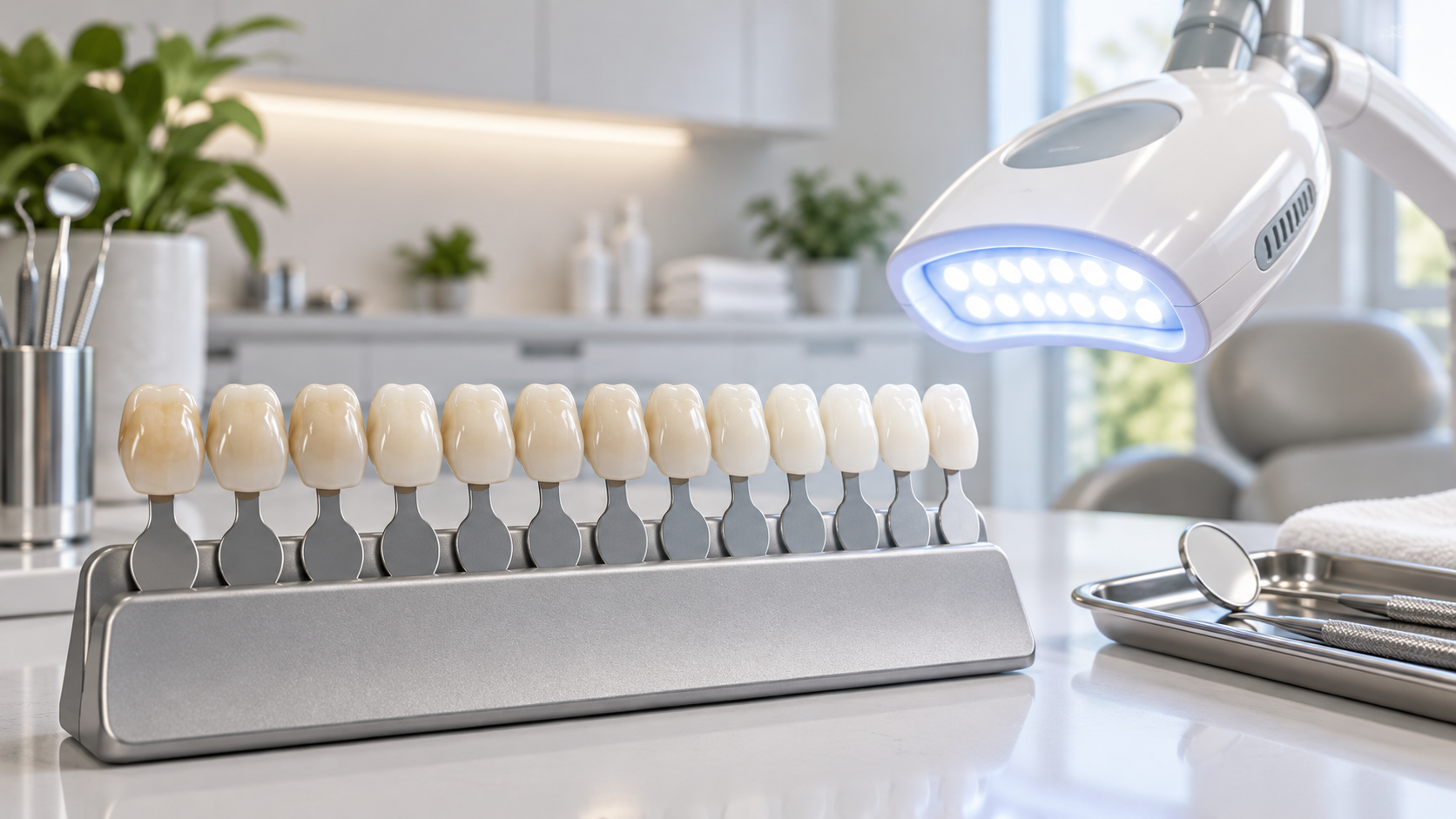
Some in-office systems use light and others do not. A lamp in an illustration or the word “laser” in a treatment name does not show which option is best for you. An umbrella review published in 2026 found no consistent advantage in final whitening from light or laser activation across the protocols assessed. This does not mean every device has no use: studies differ in their products and settings.
Distinguish activation of bleaching agents from separate light-based approaches studied for sensitivity relief; these serve different purposes. It is more useful to ask why the team selected a protocol and how sensations will be monitored. A brand name, including the widely encountered Zoom name, does not replace an explanation of ingredients, stages, limitations and follow-up.
A system’s advertising should not be taken as evidence about a particular clinic. Confirm equipment and service availability directly. This article compares approaches and does not establish that Full Clinic uses any particular device. Choosing by a photograph of a machine leaves more relevant questions unanswered: tooth health, restorations and individual tolerance.
Why fillings and crowns may look different afterwards
Whitening changes natural tooth tissues but does not lighten the material of a filling, veneer or crown. Differences may become more apparent after a course. A crown supported by an implant will not become whiter through gel application either. Before starting, identify visible restorations and discuss whether a possible combination of shades would be acceptable.
Not every filling must be replaced after whitening. Its condition, location and your preferences matter. If an aesthetic restoration is planned, the dentist coordinates the sequence and shade selection once colour has stabilised. A particular level of whiteness and a seamless match to existing materials should not both be promised without that planning.
A single dark tooth following root canal treatment is a separate situation. Internal bleaching or restoration may be considered where indicated, but internal bleaching is not a home procedure or the equivalent of a standard whole-smile course. The tooth and previous treatment are assessed first; concealing a change in colour must not take the place of diagnosis.
Setting realistic expectations
The outcome depends on the cause of staining, starting shade, tooth characteristics, restorations and adherence to the plan. Natural smiles are usually not uniform, and identical colour across every tooth is not an obligatory outcome. Some stains respond only to a limited extent. If the desired effect is not achieved, the plan needs reassessment rather than indefinite intensification.
Appearance immediately after treatment can differ from the later shade because tissue moisture changes temporarily. A comparison in the dental chair therefore does not replace review at the agreed time under consistent lighting. Assess comfort, whether the change meets your preferences and how it matches restorations, as well as shade samples. Avoid comparing your smile with an edited advertising image.
The effect is not permanent. Staining can return, at a rate influenced by habits and the starting situation. An exact number of shade steps or years of durability cannot be promised in advance. A repeat course should follow assessment of the teeth and the previous response. A sensible goal is a noticeable, acceptable change with comfort maintained, rather than the lightest possible shade at any cost.
Sensitivity and warning signs
Short-lived sensitivity to cold or sweet foods and gum irritation are recognised reactions. They can occur with professional or self-applied bleaching. Mild, temporary discomfort does not automatically mean damage, but report it to the dentist: severity and duration matter. The dentist decides whether a pause, change of regimen or examination is needed.
Severe, worsening or spontaneous pain, pain on biting and symptoms affecting one tooth should not be dismissed as routine sensitivity. If there is substantial burning, whitening of gum tissue or an injury to the oral lining, stop exposure and contact a dentist. Do not attempt to “neutralise” the product with household chemical mixtures. Do not restart before the cause is assessed or prescribe yourself medicines from this article.
Facial swelling, fever or an unpleasant taste accompanied by pain calls for urgent dental assessment. Swelling that affects breathing or swallowing or spreads towards the neck or eye requires emergency medical care rather than waiting for a whitening appointment. These are warning signs whether or not a cosmetic course has begun.
| What you notice | Next step |
|---|---|
| Brief, moderate response to cold | Tell the dentist and agree on continuation |
| Severe pain or gum injury | Stop whitening and obtain assessment |
| Swelling and fever | Seek urgent care |
| Swelling affecting breathing or swallowing | Emergency medical care |
Alternatives and DIY remedies
If deposits are the problem, professional cleaning may be enough. For particular defects, a dentist may discuss other surface treatments or restorations, whose indications differ from whitening. Veneers and crowns can change appearance, but involve more substantial intervention and should not automatically replace consideration of conservative options. Choosing no cosmetic procedure is also valid.
Shop-bought strips and gels are not interchangeable. A traceable manufacturer, ingredients, instructions and suitability for your circumstances matter. Buying from an online marketplace does not establish quality, and a universal tray may protect gums poorly. Whitening toothpaste mainly addresses surface stains and is not equivalent to a professional chemical course.
Lemon, vinegar, charcoal and homemade mixtures are not safe replacements for an agreed protocol. Acids and excessively abrasive products can damage tooth surfaces; “natural” does not mean gentle. Do not use household peroxide or mix it with other substances. If your colour concerns you, investigating the cause is a safer starting point than trying recipes on your enamel.
Maintaining the change and planning visits in Yerevan
After a course, follow the instructions for your particular system. Maintain normal hygiene: brush twice daily with fluoride toothpaste and clean between teeth with a suitable method. Do not brush harder in pursuit of whiteness. Discuss coffee, tea and tobacco, which may contribute to renewed staining. Strict universal food lists and timelines without reference to a protocol do not replace individual advice.
A review assesses stable colour, sensitivity and tissue health. Do not turn maintenance into continuous bleaching; repeated exposure should be agreed with the dentist. If a tray changes shape, a new filling is placed or your gums change, reassess the old plan. Leftover gel should not be used simply because it is still at home.
The practical questions are similar for Yerevan residents and people visiting Armenia briefly: how many visits are expected, when the result can be assessed and how to obtain help if a reaction occurs. Confirm the plan and cost before starting rather than assuming consultation, cleaning, trays and possible restoration replacement are covered by one fee. No prices or availability of a particular clinic system are asserted here.
Save before your visit
Questions worth asking your dentist
- What is causing the change in my tooth colour?
- Do I need dental treatment or professional cleaning first?
- Which method suits my sensitivity and existing restorations?
- How will my gums be protected, and what should I do if pain develops?
- When is the stable shade assessed and filling replacement considered?
- Which visits and costs are included, and how can I contact you after leaving?
Sources
- Whitening — American Dental Association
- Teeth whitening — NHS
- Tooth whitening — Oral Health Foundation
- Home-based chemical bleaching of teeth in adults — Cochrane
- Do Laser and Light Activation Improve In-Office Dental Bleaching Outcomes? — Journal of Esthetic and Restorative Dentistry / PubMed
- Clinical evaluation of in-office bleaching with low, medium, and high concentrate hydrogen peroxide — Clinical Oral Investigations / PubMed
- Policy on the Use of Dental Bleaching for Child and Adolescent Patients — American Academy of Pediatric Dentistry
- Toothache — NHS


