
 23 Tumanyan St, Yerevan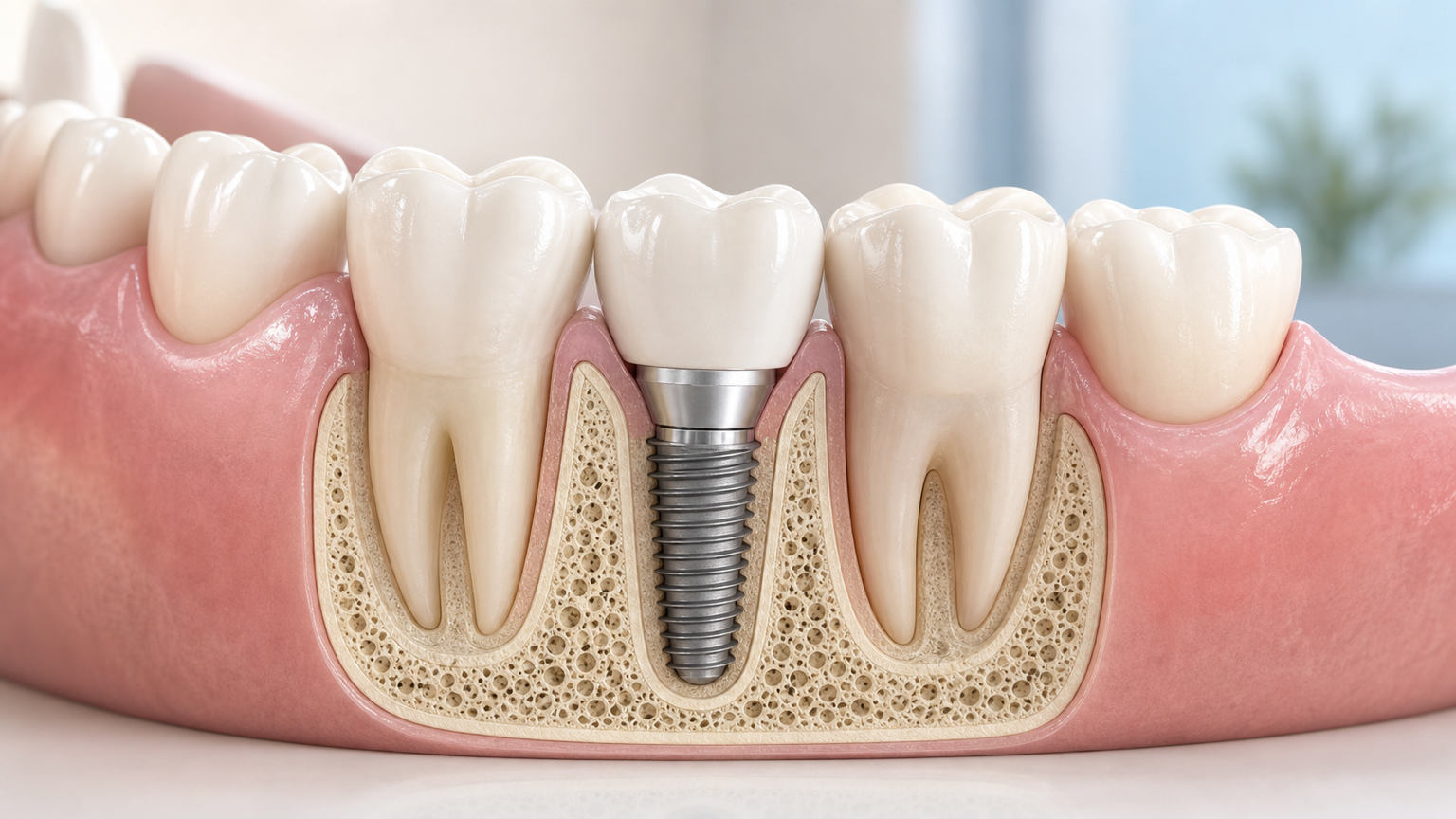
Key points in one minute
The implant is part of the system, and the result depends on the entire plan
- The implant replaces the root and serves as a support for a crown, bridge or removable structure; in itself it is not a finished tooth.
- The decision is made based on the condition of the oral cavity, bone volume, general health, hygiene and the ability to safely perform the surgical stage.
- Immediate loading is not always possible: it is chosen only under suitable anatomical conditions and sufficient primary stability.
- Long-term results require daily hygiene, follow-up visits and early treatment for pain, mobility, swelling or discharge.
What is implantation and what problem does it solve?
A dental implant is a medical device that is surgically placed into the jaw bone in place of a lost root. Above it there is a connecting element - an abutment - and a prosthetic restoration: a single crown, bridge or support for a prosthesis. Therefore, the expression “install an implant” describes only part of the treatment: the prosthetic restoration determines the appearance, contact with adjacent teeth and chewing surface.
The main objective of the method is to create independent support where the tooth is missing or cannot be preserved. With a single defect, this sometimes allows you to avoid grinding down adjacent teeth for a bridge. In case of multiple defects, implants can support a fixed or removable structure. The specific number of supports is not chosen according to an advertising formula: it depends on the location of the defect, bite, quality and volume of bone, future design and load distribution.
After placement, the bone gradually forms contact with the surface of the implant - this process is called osseointegration. It does not mean that after a few days the implant is ready for any load. Biological healing takes weeks and months, and the appropriate loading protocol is determined by the clinical situation.
Who can this method be suitable for and what limits treatment?
Implantation is considered in the absence of one, several or all teeth, if the patient needs support for a future structure and clinical conditions allow the intervention. Age by itself usually does not provide the answer. What is more important is the completeness of jaw growth in young patients, general health, tissue healing capacity and the ability to maintain hygiene.
Some conditions do not always prohibit implantation permanently, but require stabilization, a change in plan, or the involvement of the treating physician. These include uncontrolled diabetes, active periodontal disease, significant inflammation in the treatment area, smoking, certain clotting disorders, immune conditions, and medications that affect bone or healing. You cannot stop taking medications on your own for the sake of surgery.
Bone deficiency may require bone grafting, changing the position or size of the implant, or choosing a different design. If the expected benefit does not justify the surgical risk, a bridge or removable prosthesis may be a reasonable alternative. Refusing implantation in a particular situation is not a failure, but part of safe planning.
- There is a defect in the dentition that needs to be functionally restored.
- The growth of the jaws is complete, and the general condition allows for planned intervention.
- There is no uncontrolled active inflammation in the oral cavity.
- There is a sufficient amount of tissue or a realistic plan for its restoration.
- The patient is ready for daily hygiene and regular monitoring.
What diagnostics are needed before surgery?
The plan begins not with a snapshot of one missing tooth, but with an assessment of the entire system. The doctor clarifies complaints, medical history, allergies, surgeries, smoking and medications taken; evaluates teeth, gums, mucous membranes, bite, space for a crown and the quality of home hygiene. If there is caries, periodontitis or another source of infection, the treatment sequence is reviewed.
Three-dimensional examination is used when clinically necessary to assess bone volume and the location of important structures, such as the mandibular canal or maxillary sinus. Using digital data, you can plan the position of the implant relative to the future crown. But the image does not replace an examination: the decision is made up of clinical, radiological and prosthetic data.
Before agreeing to treatment, it is important for the patient to understand not only the desired scenario, but also the backup one. For example, will there be a temporary tooth, what will change if primary stability is insufficient, is bone or soft-tissue grafting possible, how many stages are expected and what alternatives remain.
- Report all medical conditions and medications, including bone and blood thinners.
- Find out what the final design is planned and how it will be cleaned.
- Ask if bone grafting or soft tissue grafting is needed and how it changes the timing.
- Discuss temporary restoration and conditions under which the original plan may change.
How is the treatment carried out and when does the tooth appear?
The usual sequence includes planning, surgical placement of the implant, healing period, soft tissue formation and prosthetics. Sometimes tooth extraction and implant placement occur on the same day; in other situations, they first wait for the extraction socket to heal. These options cannot be ranked only by speed: each has its own criteria and risks.
Loading means the attachment of the denture and the transmission of masticatory forces to the implant. According to the ITI classification, immediate loading is performed during the first week, early - between one week and two months, traditional - after a period of more than two months. However, the calendar period is not the only criterion: primary stability, bone, occlusion, treatment area, the need for bone or soft-tissue grafting and the ability to protect the temporary structure are important.
If the conditions for immediate loading are not met, the doctor may leave the implant without functional loading and use another temporary option. This does not mean that the treatment is going badly. A more careful protocol may be chosen to protect osseointegration. The total time to a permanent crown varies from person to person and may increase with bone or soft-tissue grafting or complex restoration.
| Approach | When attaching the structure | What is important to understand |
|---|---|---|
| Immediate | During the first week | Requires careful case selection and sufficient primary stability |
| Early | From one week to two months | Not suitable for every area or surgical situation |
| Traditional | After a period of more than two months | Allows more time for healing before functional loading |
What results can you expect?
The realistic goal is stable support for a comfortable, cleanable design that promotes chewing and looks natural within anatomical limits. The implant does not return a living tooth: there is no periodontal ligament around it, and the sensation of load is different. The crown is not permanent and may require repair or replacement regardless of the condition of the implant.
The prognosis is influenced by the accuracy of planning and installation, the condition of the bone and soft tissues, the quality of the prosthesis, load distribution, hygiene, smoking, diabetes control, history of periodontitis and regularity of follow-up. High survival rates in studies do not translate into a guarantee for an individual. The result is assessed not only by whether the implant remains in place, but also by the absence of inflammation, ease of cleaning, function and condition of the structure.
Aesthetic possibilities are especially dependent on the initial level of bone and gum. Additional treatments are sometimes needed in the smile area, and the gum line may differ from the idealized image. It is better to discuss these restrictions before surgery and record the expected result in clear words.
Risks, complications and alternatives
Like any surgical treatment, implantation carries the risk of pain, swelling, bleeding, infection and damage to adjacent structures. Possible sensory disturbances due to the proximity of the nerve, problems in the sinus area, insufficient integration, mobility of the implant, loosening of the screw, chipping or wear of the prosthetic component. Some complications arise early, others occur years later.
Inflammation of the soft tissue around the implant is called peri-implant mucositis; when the supporting bone is involved, it is referred to as peri-implantitis. Bleeding on brushing, persistent swelling, foul taste, or discharge require evaluation, even if there is no pain. Early detection usually leaves more room for disease control.
The alternatives depend on the defect: observation without restoration, an adhesive or classic bridge, a partial or complete denture, and sometimes saving the natural tooth after other treatment. Every alternative has limitations. The volume of intervention, the impact on neighboring teeth, maintainability, hygiene, timing and the total cost of the entire cycle should be compared, and not just the price of one stage.
Post-treatment care and long-term follow-up
In the first days, follow the doctor’s individual postoperative instructions and do not check the implant with your fingers or by constantly pressing your tongue. Medicines are taken only as prescribed. If symptoms worsen instead of gradually decreasing, it is better to contact the clinic rather than change treatment yourself.
After prosthetics, the implant and structure are cleaned daily. The necessary means depend on the shape of the crown or prosthesis: it can be a regular brush, interdental brushes, a specially shaped thread or an irrigator as an addition, but not a universal replacement for mechanical cleaning. The doctor or hygienist must show access to areas under the structure.
Follow-up visits allow you to evaluate the gums, hygiene, bite, condition of the screws and prosthesis, and, if indicated, the level of the bone. The frequency is determined by individual risk. The implant may not hurt for a long time when inflammation begins, so the absence of symptoms does not remove the need for follow-up.
- Normal early stage may include moderate pain, swelling and slight bleeding if they gradually decrease.
- Not normal - increasing pain, persistent bleeding, pus, temperature, increasing swelling or mobility.
- After completion of prosthetics, the reason for a visit is bleeding, unpleasant smell or taste, difficulty in cleaning, chipping, changes in bite or mobility of the structure.
- Smoking impairs healing and long-term prognosis; refusal or risk reduction should be discussed before intervention.
Save before your visit
Questions worth asking your dentist
- What design is planned in the end and why was this option chosen?
- Is there enough bone and soft tissue? Will additional bone or soft-tissue grafting be required?
- Is it possible to install an implant immediately after removal and is immediate loading safe in my case?
- What will the temporary restoration before the permanent crown look like?
- What risks are associated specifically with my diseases, medications, smoking and gum condition?
- How to clean the future structure and how often to come for inspection?
Sources
- Dental Implants: What You Should Know — U.S. Food and Drug Administration
- Implant Placement and Loading Protocols — International Team for Implantology
- Guideline on treatment of peri-implant diseases — European Federation of Periodontology
- Dental Implant Procedures — American Academy of Periodontology


