
 23 Tumanyan St, Yerevan
Key points in one minute
What guides the choice
- Assess the neighbouring teeth and tissues before choosing a restoration: the material alone does not determine the plan.
- An implant involves surgery; a conventional bridge involves preparing supporting teeth. Resin-bonded bridges have specific indications.
- Compare the whole pathway, including a temporary tooth, tissue treatment, the final restoration, maintenance and potential repairs.
What are the two options?
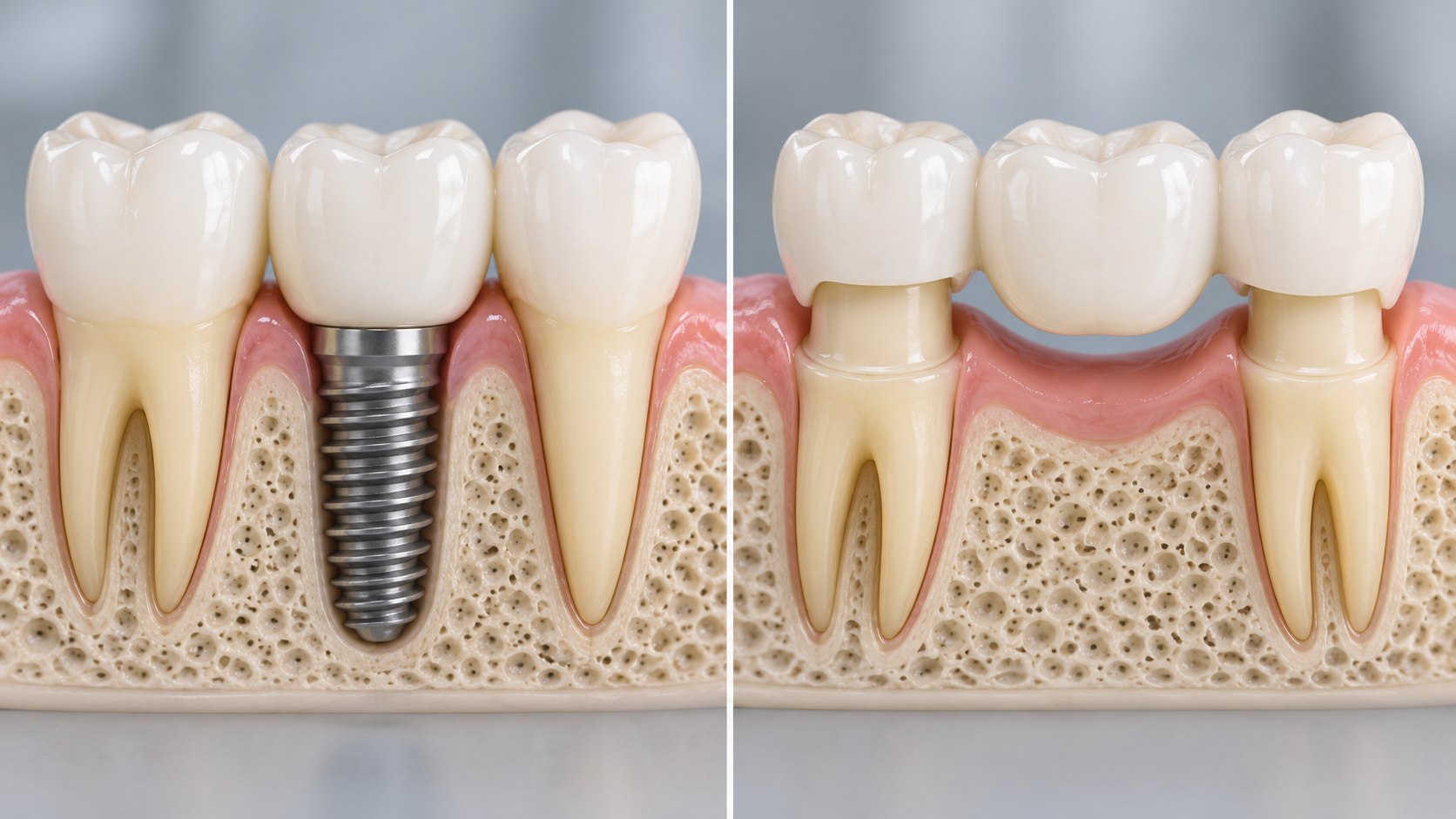
An implant is a support placed in the jawbone. Replacing a single tooth also requires a connecting component and a crown. The metal implant alone is not a finished tooth: the discussion should cover the complete system and its maintenance.
A conventional bridge joins the replacement tooth to crowns on neighbouring teeth, which carry the load. Those teeth usually need to be prepared. The health and outlook of each supporting tooth matter as much as the appearance of the new restoration.
The assessment comes first
The dentist checks why the tooth was lost, how long the gap has been present, gum health, decay, tooth mobility and the bite. Space for the crown, the smile line and access for cleaning also matter. Being able to fit a restoration does not necessarily make it easy to maintain.
Imaging should answer a clinical question. Implant planning often involves a three-dimensional assessment of bone and nearby anatomical structures. A photograph or panoramic image without an examination cannot reliably settle the choice. Discuss smoking, long-term conditions, medication and tooth grinding; do not stop prescribed treatment yourself.
When an implant may be considered
A separate implant crown avoids preparing sound neighbouring teeth. This is especially relevant when those teeth are intact. Suitable tissues, space for the restoration and a safe surgical pathway are still needed. Limited bone may lead to a discussion about augmentation, adding time, risks and cost.
Implants are not suitable for everyone. Active oral disease needs to be controlled first. General health, smoking, previous periodontitis and some medicines affect risk assessment. Implant placement is usually deferred while a patient is still growing. Suitability is individual; age or a diagnosis alone does not decide it.
Conventional and resin-bonded bridges
A conventional bridge may make sense when neighbouring teeth have large restorations or already need crowns, provided their roots and supporting tissues are suitable. It replaces the tooth without surgery at the gap, but cannot overcome a poor outlook for the supporting teeth. Preparing a sound tooth is irreversible.
A resin-bonded bridge uses a wing bonded to a neighbouring tooth, generally with little or no preparation. It is a distinct option, rather than simply a cheaper conventional bridge. Enamel, the bite, the location of the gap and loading limit its use. It can become detached; rebonding may be possible after the cause has been assessed.
Timing and a temporary tooth
A bridge can often be made sooner if the supporting teeth and gums are ready. Decay, root canal treatment, inflammation, healing after extraction and laboratory stages can extend the pathway. Speed should not come at the expense of preparing healthy tissues.
An implant pathway includes surgery, healing, integration with bone and crown fabrication. It often takes months, and grafting may extend it. An immediate temporary crown is suitable only in selected circumstances and does not mean unrestricted chewing from day one. Establish how the gap will be covered and what restrictions apply before treatment starts.
| Criterion | Implant and crown | Conventional bridge |
|---|---|---|
| Support | Implant in bone | Neighbouring teeth |
| Adjacent teeth | Usually no preparation | Usually require preparation |
| Surgery | Required; grafting sometimes needed | Not required for the bridge itself |
| Timing | Often months, depending on healing | Often shorter if supports are ready |
| Cleaning | Around the crown and between teeth | Around supports and under the replacement tooth |
| Repairs | Crown, connection or implant support | A supporting-tooth problem may affect the whole bridge |
Risks, service life and repairs
Implant risks include surgical complications, failure to integrate, inflammation around the implant and bone loss. Its crown or connection may need repair. A bridge can develop decay at crown margins, gum problems, loss of retention or damage to the pulp of a supporting tooth, sometimes requiring root canal treatment. Neither option rules out further intervention.
Service life depends on the initial tissues, loading, cleaning and follow-up. An implant remaining in the bone and a crown remaining repair-free are different outcomes. A problem in one supporting tooth can affect an entire bridge. Ask whether the restoration can be removed, individual components replaced and compatible parts sourced later. A lifetime promise does not answer those practical questions.
Cleaning and comfort
Neither restoration is removed by the patient, but cleaning access differs. Clean beneath the replacement tooth of a bridge along the gum line, and around an implant crown and between adjacent teeth. Ask for a demonstration of suitable tools and check that you can use them. A water flosser does not replace mechanical plaque removal.
A short period of adjustment to the new tooth shape can occur. However, a bite that feels too high, persistent food trapping, pain on chewing, movement or bleeding needs assessment. Do not file, tighten or glue the restoration yourself. Review and professional cleaning intervals should reflect your individual risks.
Compare the complete cost
Compare written plans for the same goal: replacing one tooth, rather than buying one component. For an implant, clarify imaging, surgery, possible grafting, the abutment and temporary and final crowns. For a bridge, clarify preparation, temporary bridgework, laboratory stages and any initial treatment of the supporting teeth. A clinic in Yerevan can provide an individual price after assessment.
Discuss maintenance, repairs, replacement parts and warranty terms separately. A low starting price does not describe future expenditure. If you travel from another city or country, consider repeat journeys, review timing and access to care at home. Request copies of the plan, restoration details and instructions in a language you understand.
Alternatives and a practical decision sequence
Other options in selected cases include a removable partial denture, orthodontic space closure or monitoring without immediate replacement. Suitability depends on function, appearance, tooth position and the risk of change. Not every gap needs the same solution, but leaving it unassessed is unhelpful.
A useful sequence is to control active disease, assess the teeth and bone, compare suitable options against the same criteria and agree a temporary stage. If a recommendation is unclear, ask for an explanation or a second opinion before an irreversible step. Someone else’s experience cannot predict how your tissues will respond.
Expected recovery and warning signs
Mild pain and swelling after surgery can be expected when they follow the recovery pattern explained by the clinician and improve. A new restoration may initially feel unfamiliar. An article cannot establish the cause of an individual symptom: follow your own postoperative instructions.
Increasing pain or swelling, pus, fever, bleeding that does not stop, persistent numbness or movement calls for prompt contact with the treating team. Difficulty breathing or swallowing and rapidly spreading swelling require emergency care. Do not wait for a routine review if your condition is worsening.
Save before your visit
Questions worth asking your dentist
- Why does this option suit my teeth, and what alternatives are available?
- Will I need bone grafting, gum treatment or preparation of neighbouring teeth?
- Which stages and costs are included in the written plan, and which are separate?
- How will I clean the restoration, and who can help if a problem occurs after I leave Yerevan?
Sources
- Dental implants: benefits and risks — FDA
- Dental implants in restorative dentistry — Cambridge University Hospitals
- Dental bridges — Leeds Teaching Hospitals
- Dental implants — Leeds Teaching Hospitals
- Resin-bonded bridges — University of Bristol


