
 23 Tumanyan St, Yerevan
Key points in one minute
Before choosing a procedure
- Establish the cause of your concern and the health of the tissues before choosing how to change your smile.
- Colour, shape, tooth position and gum contours are separate concerns; a single procedure may not address them all.
- Discussing speech and trying a proposed shape can be more useful than a promise to copy a photograph.
- Monitoring, limited changes and staged treatment are valid options; irreversible work needs a clear rationale.
Start with a goal, rather than an ideal
Describe one specific situation: you dislike the shade in daylight, notice an old chip, struggle with a sound when wearing a denture, or feel uncomfortable smiling for photographs. These are different concerns. Ask the dentist to distinguish a cosmetic preference from disease or a functional problem. Changing your appearance cannot guarantee confidence and should not become a prerequisite for taking part in ordinary life.
Bring photographs of your own smile that you like and explain what you would prefer to keep. Someone else’s photograph can help communicate an idea, but cannot define an achievable outcome: the starting tissues, bite and lip movements differ. There is no automatic need to change every visible tooth simply to use the same material throughout.
Assessing teeth, gums, face and bite together
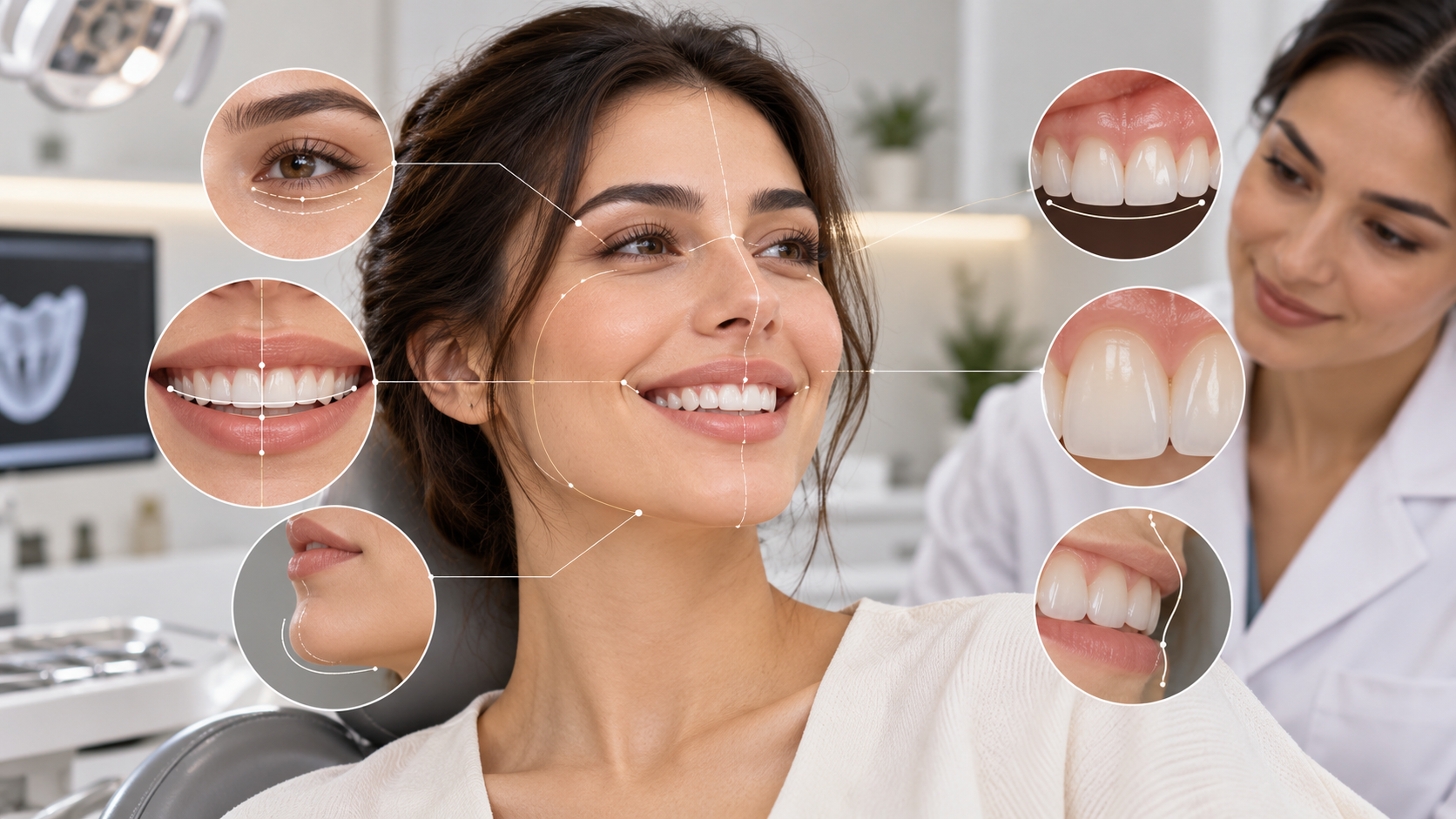
A dentist considers the smile at rest and in motion: which teeth show during conversation, how the lips frame them, where the gum margins sit, and how the visible crowns relate in width and length. No single ideal proportion or symmetry line establishes a need for treatment. Differences between neighbouring teeth or between the two sides of a smile can be individual features.
Photographs are only part of an assessment. An examination checks for decay, the condition of fillings and gums, tooth stability, biting contacts and signs of excessive loading. Imaging and other investigations should follow a clinical need, rather than being automatic additions to a digital design. A visual simulation can help agree preferences, but cannot establish the health of roots or supporting tissues on its own.
Colour: cleaning, whitening and restorations do different jobs
Surface staining is different from the underlying shade of a tooth. The cause of a colour change needs to be understood first. A single tooth that suddenly darkens, especially after an injury, needs assessment rather than self-directed whitening. Discuss your preferred shade in suitable lighting, taking existing fillings and crowns into account.
The ADA explains that whitening does not lighten crowns, veneers or fillings, and does not work equally well for every type of discolouration. Sensitivity can occur. If restorations are also planned, agree the sequence and shade selection in advance. Avoid acids, household bleach and aggressive scraping: experimenting at home does not identify the cause.
Options to discuss, and what each leaves unresolved
The appropriate approach depends on the concern and the condition of the tissues. A cosmetic complaint does not automatically justify preparing healthy teeth. Ask whether a smaller intervention could produce a change you would find acceptable, and what monitoring without treatment would involve. Where there is no disease, choosing to postpone an elective procedure can be a considered decision.
| Concern | Possible direction | Limitation |
|---|---|---|
| Plaque and surface stains | Oral hygiene and professional cleaning where indicated | Does not move teeth or replace treatment for decay |
| Underlying tooth shade | Discuss whitening | Does not lighten fillings or crowns; sensitivity is possible |
| A small shape defect | A local composite restoration | May require repair and maintenance |
| Tooth position | An orthodontic assessment | Requires time, hygiene and retention |
| Front surface appearance | Discuss veneers | May involve irreversible preparation and ongoing care |
| A damaged or missing tooth | Restoration or replacement where indicated | Needs assessment of support, bite and alternatives |
Shape and gum contours: what changes in the tissues
Decay and gum disease need treatment before veneers. The ADA notes that preparation involving enamel removal is irreversible, and veneers may become damaged and need repair or replacement. Clenching or grinding makes it particularly important to discuss limitations. A crown and a veneer are different restorations, with different coverage and preparation requirements.
If the amount of visible gum concerns you, ask what causes it: lip position, tooth shape and position, gum margins, or several factors together. Bleeding or inflammation needs assessment first. Wanting to change a “gummy smile” does not, on its own, establish a need for surgery. Ask which tissues would be changed, whether less invasive approaches are possible and what aftercare would involve.
Crowding is a reason to discuss orthodontic assessment, rather than only masking tooth positions with restorations. NHS guidance emphasises good hygiene before and during tooth movement, the risk of decay and gum problems, and the need for retainers afterwards. A quick visual change does not necessarily address the bite.
Teeth, dentures and speech: check them in conversation
The shape of front teeth and the space available for the tongue can affect how speaking feels. This is especially worth discussing if you teach, give presentations or use several languages every day. At a try-in, use familiar phrases in Armenian, Russian or English: everyday speech matters as well as the view in a mirror. Note which sound has changed and when you notice it.
Speech can initially feel different with a new removable denture. CUH guidance suggests practice and reading aloud. Adaptation varies between people. This advice should not be transferred automatically to every crown or veneer, with a promise that any difficulty will resolve by itself. A denture that clicks, slips or hurts needs a dental review.
Do not file your teeth or denture yourself, or use household glue to alter the fit. If speech remains difficult, the dentist can check the restoration and consider other causes. Cosmetic dentistry is not a universal treatment for a speech disorder; an assessment by another professional may be appropriate.
Agreeing a result before an irreversible stage
Ask the dentist to show what changes are proposed and why. Photographs, models, a digital design or a trial shape may support that discussion where suitable for your situation. They cannot guarantee an exact final match. Clarify what a trial is intended to check: tooth display, the length of the biting edges, contacts, lip and tongue comfort, or sounds in conversation.
Set out your priorities: which shade feels natural, what you do not want changed, how many stages you can attend and how you feel about future repairs. The plan should cover alternatives, risks, preparation, maintenance and follow-up. If the explanation remains unclear, taking time or seeking a second opinion before agreeing to irreversible preparation is reasonable.
For example, “straighter and lighter” does not establish a plan for veneers. Tooth position, plaque, underlying shade and a small chip can be discussed separately. This is an example of how to organise questions, rather than a patient story or a recommendation for a particular treatment.
Individual variation versus a reason to seek care
Imperfect symmetry, a personal tooth shade and minor differences in shape without symptoms do not automatically need correction. Sudden changes, pain, bleeding, a loose tooth, a sharp broken edge or new difficulty chewing are reasons to assess the cause. They should not be dismissed as purely cosmetic.
Unfamiliar sensations with a new denture may gradually settle. Pain, rubbing, marked redness, poor fit or persistent speech difficulty need a review. Increasing facial swelling or difficulty swallowing or breathing requires urgent medical help; cosmetic planning can wait.
Protecting health after a change
Restorations and dentures do not remove the need for daily cleaning and dental reviews. Ask for a demonstration of how to clean your particular restoration and between your teeth. Removable dentures need separate cleaning, and their care differs from that of natural teeth. Review intervals should reflect the tissues and restoration, rather than a universal timetable from an article.
Find out in advance what to do if something chips, loosens or changes your bite. Do not test a restoration by biting hard objects. If you clench or have tooth wear, discuss this as a separate concern: changing the appearance of a smile does not automatically remove the cause of excessive loading.
Preparing for a consultation in Yerevan
Bring existing reports and images, information about medicines and allergies, and details of previous restorations. Do not arrange new investigations solely because of this article. Say which language you prefer for detailed discussions and request a written plan in terms you understand. Conditions, timing and costs need confirmation after an examination; this article does not establish that the clinic offers a particular technology.
If you are visiting Armenia briefly, agree the stages, try-ins, adaptation period and follow-up before buying tickets. Ask who to contact after you leave and which records to take with you. A convenient travel date should not replace clinical reasoning or take away time to decide. This article is general information and does not replace an individual treatment plan.
Save before your visit
Questions worth asking your dentist
- Which parts of my concern relate to health, and which are cosmetic preferences?
- Could monitoring or a smaller intervention be sufficient?
- Which tissues would be changed irreversibly, and what are the alternatives?
- How will we check speech, chewing and shape before completion?
- What cleaning, repairs and follow-up might be needed afterwards?
Sources
- Veneers: preparation and limitations — ADA
- Teeth whitening: effects and sensitivity — ADA
- Orthodontics: treatment and retention — NHS
- Denture care and speech adaptation — Cambridge University Hospitals
- Dentures: care and when to seek a review — NHS


